Monthly Archives: September 2009

Tufts, CNN Screw Jumbos For Screwing

Ah, the power of the media to mislead. This truly riveting segment from a Massachusetts CNN affiliate reveals a new Tufts University policy against getting it on while your roommate is in the room and that prohibits “sexiling.” The piece confuses on two counts.

It makes Tufts students look like idiots and implies that they are getting lucky. That’s not how I remember it. Well, to be fair, there were plenty of idiots there.

Afghan Girl Killed by British Airforce Propaganda Leaflets

We all hear plenty about the Death of Print, but rarely of Death by Print.

According to the BBC, a box of informational pamphlets dropped over a rural province of Afghanistan by Britain’s Royal Air Force struck and killed a young woman in June.

The box was supposed to open in midair, letting the leaflets’ message (about free elections or somesuch Democratic nonsense) float peacefully to the ground. A light sprinkling of liberation. But it failed to break apart during free fall and landed intact on the girl, who died later in a hospital.

“Leaflet drops,” said the BBC piece, “have been used extensively in Afghanistan by US and British forces in the battle to win the ‘hearts and minds’ of the local population.” Not this time, I reckon.

(BBC, from Wired via Boing Boing)

Skateboard Tetris Video Rocks, Rolls, Spins, Fits

Demonstrating once again that the quickest way to my heart is through my Nintendo, here’s a doozy of a skate video from a troupe of intrepid rollers on the hilly streets of San Fran.

If more kids played video games this way maybe there wouldn’t be so many fatties waddling around. Just sayin.

(Via Make)

A Sad Day for English: William Safire’s Passing

William Safire, a speechwriter for President Richard M. Nixon and a Pulitzer Prize-winning political columnist for The New York Times who also wrote novels, books on politics and a Malaprop’s treasury of articles on language, died at a hospice in Rockville, Md., on Sunday. He was 79.

NYTimes, Sept 27, 2009

Over the weekend we lost our country’s most popular authority on words, the preeminent pundit of parlance. William Safire’s weekly On Language column in the New York Times Magazine was to usage mavens what US Weekly is to celeb-o-philes, and has been, to me, a consistent source of intellectual delight and professional inspiration. In fact, in June of last year Safire briefly noted at the end of an article that his researcher had taken another job. I took that as a cue, and sent him an earnest, if obsequious email pleading for the opportunity to apply. “I have oft pondered ways,” I admitted, “that I might scam my way under your tutelage.” (I received a call a few days later for an interview. Unfortunately the job was in DC. In retrospect, perhaps I should have considered the relo.)

From the Times obit:

The columns, many collected in books, made him an unofficial arbiter of usage and one of the most widely read writers on language. It also tapped into the lighter side of the dour-looking Mr. Safire: a Pickwickian quibbler who gleefully pounced on gaffes, inexactitudes, neologisms, misnomers, solecisms and perversely peccant puns, like “the president’s populism” and “the first lady’s momulism,” written during the Carter presidency.

There were columns on blogosphere blargon, tarnation-heck euphemisms, dastardly subjunctives and even Barack and Michelle Obama’s fist bumps. And there were Safire “rules for writers”: Remember to never split an infinitive. Take the bull by the hand and avoid mixing metaphors. Proofread carefully to see if you words out. Avoid clichés like the plague. And don’t overuse exclamation marks!!

I should have known those rules were his.

I doff my digital cap to Mr. Safire. Here’s hoping I can help forward the cause for correctness on Earth, and that heaven offers an abundance of malapropisms, lest eternity be boring.

Attack of the Memes: Twebinar

twebinar

I have a new least favorite word. I received a press release this morning announcing a “twebinar” taking place today. That’s right, a twebinar.

Twebinar (n): Webex Webinar + Live Twitter Session

Explains the release:

To post your questions and participate via Twitter, please follow Kevin Mallon at: http://www.twitter.com/kevin_at_fmi and use the hashtag #Bento3 in your tweets so that we will be able to respond to them immediately. The webinar portion of the discussion will run from 11:00am – 12:00pm PST, but we will be monitoring and responding live to the Twitter feed from 11:00am-1:00pm PST

Honorable mention to Twibes, the pwecious descwiption for Twitter-unaffiliated Twitter groups at Twibes.com.

Google Game: Withdrawal

Yesterday, while reflecting on the Jewish high holy day of Yom Kippur I thought about Google-searching for atonement. But that was soon replaced by a fixation on being hungry, which was then supplanted by the cranium stabbing sabers of a mondo caffeine withdrawal headache. As I went through a cruel and dismal day without coffee, I became curious about what others were withdrawing or withdrawing from.

gg withdrawal

At first blush, it’s a pretty dire picture. We’re hooked on nicotine and booze and pain killers. And we’re depressed. And we’re running low on liquidity. But on the bright side, we’re trying to get off the cigs and the sauce and the pills. And at least some of us are getting it on. (Whoever they are, let’s hope their attempts to do so without getting knocked up are working; if you’re searching the Internet for tips on the withdrawal method, the gene pool kindly declines your deposit.)

So to recap – Name four things people withdraw from. (Show me Iraq.)
Survey says:

drugsfam feud
alcohol
the bank
your vagina

Chatspeak Shows No Effect on Spelling, May Improve Haikus

Child development researchers at the University of Alberta reported last week that using common text and IM abbreviations, or “chatspeak,” does not affect kids’ spelling aptitude. My first reaction to the results was dismay. I wanted proof that today’s youth are getting dumber. Dumber, at least, than the youth of, well, my youth. But upon reflection, and with all due respect to the intentions of the study, I think the premise is fundamentally misaligned.

I’ve maligned the overuse of AOLanguage for years, and its epidemic penetration never ceases to annoy. Although it may well reinforce already established bad habits, digital lingo has very little to do with standard spoken and formal written English. It’s a dialect unto itself. Kids likely don’t think that writing a text and taking a spelling test are in any way related. And really, they aren’t. Sure, children might write “UR” instead of “your,” but make them memorize how to spell “definite” and “maintenance” and they’re going to do it. Similarly, they’ll read To Kill a Mockingbird for class, but on their own it’s all Tiger Beat and Mad Magazine. (Kids still read that stuff, don’t they?)

What’s troubling in the wide view is that people use messenger and text and facebook walls as communicative crutches. Not just the youngins; we grown-ups are just as guilty. Social interactions take places less and less frequently in social settings and more and more often in social networks, and our face-to-face muscles are withering in atrophy. I have come to wonder, for instance, how exactly people go from being friends-of-friends to dating without first connecting on facebook (or at least without a little facebook stalking), which is particularly disturbing given the fact that I’m not on the facebook.

According to the university press release,

[Authors Connie Varnhagen and Nicole Pugh] both agree that the results of their study should ease some concerns and even open up discussion on how this language can be perhaps be embraced within an educational or academic context.

“If you want students to think very precisely and concisely and be able to express themselves, it might be interesting to have them create instant messages with ideas, maybe allow them opportunities to use more of this new dialect in brief reports or fun activities,” said Varnhagen.

Thought-provoking idea, but here’s another one. Instead of encouraging malleable young minds to regard IMs as vehicles for academic thought, perhaps it’d be better to set aside cell phones and 140-character limits and make them practice actually talking to people. Like, with their mouths.

Giants Stadium Hosts Breathtaking Video Display of U2 Live Performance (U2 Reportedly Performs Below It)

Saw U2 at Giants Stadium last night. Ahem, and the night before. Amazing show? Obviously. It’s U2. Bono is the ultimate showman (even if he can’t remember the words to his songs anymore) and the band’s as tight as ever (even if Larry Mullen Jr.’s starting to look a little tired). This was no question.

The stage was impressive, a transplantable theater in the round, surmounted by an enormous claw-like structure supporting a 360-degree jumbotron of the highest-resolution I’ve ever seen. Hilariously, Drum Master Mullen was quoted in the September issue of Spin as saying, in re the set up, “We don’t need another Pop Mart.” Yeah, this was much more tasteful and restrained than the giant lemon, sure.

downsized 0924092112

0924092225

In the same brief article, Bono explains that on tour the band aims to let the latest technologies push their shows to new levels. And I will certainly give them that. The screen was good. It was real good. In fact, it was too good.

Continue reading

Edit or Get off the Pot [UPDATED]

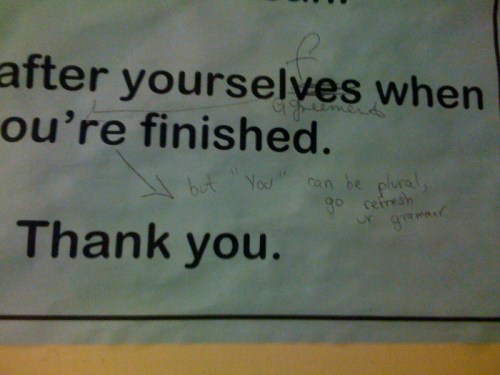
Attention students: the editing bug is going around. Thanks to Kim for sending this shot taken of a sign in a ladies’ room at Downstate Medical School.

photo

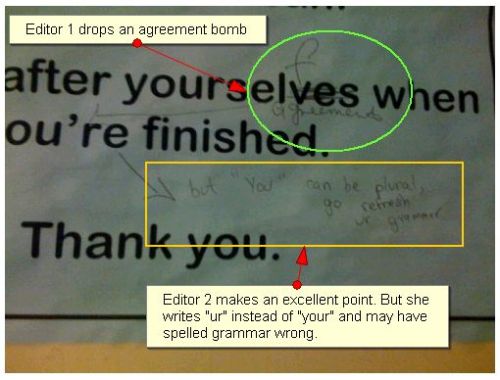
The play by play as I see it:

photo annotatedA for effort, girls. The first step toward proper grammar is acknowledging that you have a problem. If med students in the middle of exams have time to think about usage — while on the potty, to boot! — maybe there’s hope for the rest of us.
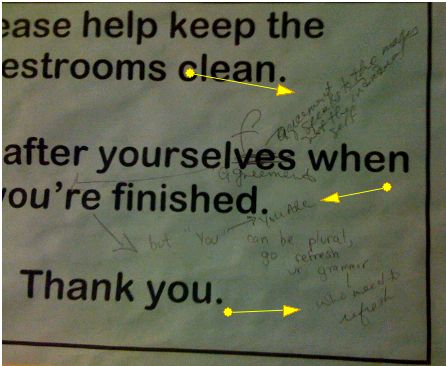
Update: September 29. The battle rages on….

photo(2) annotated
This could get ugly.

The Reluctant Technologist on Mattel’s Mindflex

Come on Schwartz. Come on Schwartz.

Come on Schwartz. Come on Schwartz.

The fundamental premise of the Mattel Mindflex makes it one of the coolest games ever. Seriously, ever. (Note, I didn’t say most fun, I said coolest. There’s a difference.) The object is to move stuff with your mind. Here’s the gist: You put this doodad on your head, then you stare at this li’l Nerf ball real hard, then suddenly the ball starts floating. You levitate the thing. It’s pretty trippy.

I tested this out a few months ago and wrote about it for Popular Science. The itch to try it for myself was strong enough that I actually put that ridiculous thing on my head in a public place, and tried to be the ball. The headband has a sensor — a dry contact electrode — that rests on your forehead just above the left eyebrow, over the SP-1 region of your brain’s frontal lobe. That’s the part of your noodle involved in things like problem solving, motor function, memory, language and judgment. (Clips on your ear lobes take a baseline reading as a control.) When activity in the area increases, the game runs an algorithm to translate that into a level of concentration, which then determines the level, or height of the ball. The headband and game base communicate over a wireless bandwidth similar to Bluetooth. Amazingly, you look like even more of an asshole in this contraption than the jerks with their LED-flashing earpieces. Added bonus.

Continue reading