Monthly Archives: February 2010

Prof Voids Laptop Warranty with Liquid Nitrogen

This demonstration in an OU physics course was intended to teach students not to bring laptops to class. The real takeaway? This would feel so freaking good:

Boy, talk about your computer freezing. Ba-zing!

For more fun uses of liquid nitrogen, check out this video from the chef of El Bulli and food author Harold McGee and get your hands on a copy of Jason X. Trust me.

[From Make via Engadget]

Un-Advertising: Your Commute, Now With Social Commentary

If you’re an LA commuter running out of things to say to the people in your car pool, try planning your route to work past the sites of the 21 soaring pieces of art in the MAK Center’s city-wide exhibition How Many Billboards? Art in Stead. (There’s an updated map of locations on the site.) Up through March, the project’s central idea is that, in the words of the director, Kimberli Meyer,

art should occupy a visible position in the cacophony of mediated images in the city, and it should do so without merely adding to the visual noise. How Many Billboards? Art In Stead proposes that art periodically displace advertisement in the urban environment.

Billboards are a dominant feature of the landscape in Los Angeles. Thousands line the city’s thoroughfares, delivering high-end commercial messages to a repeat audience. Given outdoor advertising’s strong presence in public space, it seems reasonable and exciting to set up the possibility for art to be present in this field. The sudden existence of artistic speech mixed in with commercial speech provides a refreshing change of pace. Commercial messaging tells you to buy; artistic messaging encourages you to look and to think.

Think of good, for example:

Or how big a snowball a person can fit in his mouth:

[Via UrbanDaddy. Thanks, Hilla]

Tufts YouTube Admissions Essays Total (Up)Load of Shit

This is on Tufts' undergrad admissions page. Who's jerking whom around here? Becoming a Jumbo is one giant Elephant Walk.

When I was in high school, the Brown University application included an essay that you had to write by hand. I thought it was stupid, but I also thought the college might accept me, so I went along with it. Later I heard about a girl who wrote her essay in a spiral that filled the page from the center out. I never would have thought of that. I realized that, no, I guess I wasn’t Brown material.

But I was Tufts material, which, I found out when I got there, didn’t really mean… anything. The school was liberal, but not lock-yourself-in-the-campus-center liberal. There was a conservative journal, too, though any association therewith was vilifying. It had artsy students, but they had their own house (I mean, “haus”), and enginerds and even a couple frats and sororities (shudder to think). And it boasted a degree of diversity, enrolling students from both the North and South shores of Long Island. It certainly never felt particularly progressive. (I heard Brown doesn’t even give grades!)

But according to the New York Times, Tufts is a beacon of collegiate innovation:

It is reading season at the Tufts University admissions office, time to plow through thousands of essays and transcripts and recommendations — and this year, for the first time, short YouTube videos that students could post to supplement their application.

About 1,000 of the 15,000 applicants submitted videos. Some have gotten thousands of hits on YouTube.

Tufts, which, like the University of Chicago, is known for its quirky applications, invited the YouTube videos. Along with the required essays, Tufts has for years offered applicants an array of optional essays — “Are we alone?” is one of this year’s topics — or a chance to “create something” out of a sheet of paper. So it was not too far a stretch, this year, to add the option of posting a one-minute video that “says something about you.”

Known for its quirky applications? I missed that one. I only applied to Tufts because it was on the common app. Digital video? I think not. Photocopy? Yes, ma’am.

You can scroll through some of the videos here. I’m fairly impressed by the stop motion stuff, but the rest of it makes me feel uncomfortable. There’s little more unsettling than teenage earnestness. If these YouTube applications are an indication of what to expect for the future of Tufts, I think it can be summed up in four words: Hebrew hip hop raves.

[Thanks, Jess]

Google Game: Less is Fewer (Going Farther to Further Your Edification)

This week, I’ll use the Google Game as an excuse to provide yet another mini-grammar lesson. Today’s class: Less than versus Fewer than.

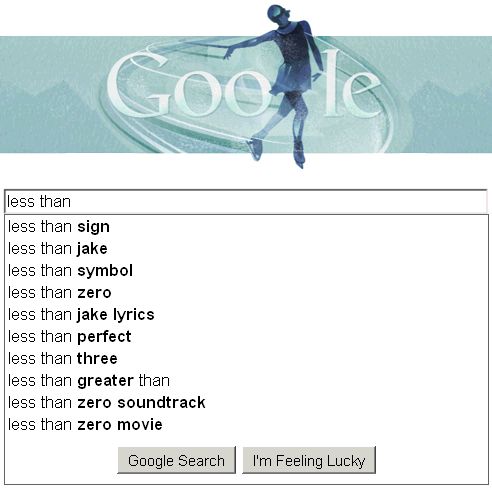
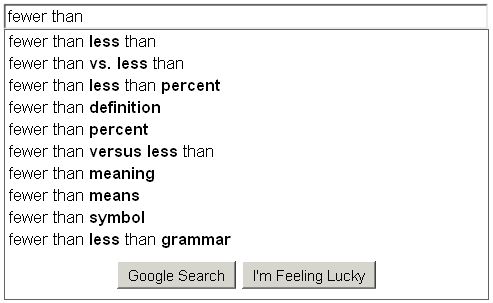
Searching Google for “less than” brings you ska bands, 80s novels and some obscure Andy Dick sitcom. But search for “fewer than,” less-than’s bookish cousin, and you get queries clearly demonstrating that no one else knows how/when they’re supposed to use “fewer” either.

The basic rule is: If you can count it, use fewer; if you can’t, less. Example:

There are fewer jelly beans in this jar than that jar.
I have less interest in how many jelly beans there are than in how to get them into my face.

The can-you-count-it rule can occasionally returns different results for seemingly the same subject. EG Time. I have less time to do this than I need. (The object, time, is indefinite.) I spent fewer hours on the project than I thought I’d need. (You thought you needed a certain — definite — number of hours, you used fewer than that.) Also consider something like sand: There’s less sand in a minute timer than a 3-minute timer. VS I counted the grains of sand in each timer, there are indeed fewer in the minute one.

Similar questions might arise when determining whether to use “farther” or “further.” According to Webster’s:

Farther and further have been used more or less interchangeably throughout most of their history, but currently they are showing signs of diverging…. A polarizing process appears to be taking place in their adjective use. Farther is taking over the meaning of distance <the farther shore> and further the meaning of addition <needed no further invitation>.

Imagine: physical distance = farther. (Get it? Far?)

But that’s if you’re keen to keep up with current linguistic trends. Webster’s says it’s historically kosher to use further and farther interchangeably when distance is involved, whether that distance is literal (It’s fa/urther from the subway), or metaphorical (He has fa/urther to go before he’ll be ready). But when there’s no notion of distance, further is always your man: This matter needs to be further explored; Further, you have more studying to do.

Got any questions of your own about esoteric adjectives and adverbs? Feel free to send me your queries and I’ll Google the answers for you.

History of the Internet (Right up to the Good Part)

Happy Monday, Nerds. Ever wonder how the internet started? No? Oh, well, once upon a time there was no internet. And then this stuff happened, and then some other stuff, like Eudora in the late 80s and Netscape in the mid 90s, and then your mom started contacting all your friends on facebook. This video, created by a recent “communication design” graduate in Germany, Melih Bilgil, takes a look at how it all began. I kind of love the retro educational film-reel feel.

A warning to true, God-fearin, freedom-lovin ‘Mercans — you’re about to find out so I may as well tell you: the word “Internet” originated in, gulp, France. (Contrary to popular belief.)

Vodpod videos no longer available.

True, it ends just as things are getting good. Look for Part II: Porn Takes Over and Part III: Update or Die! (wherein individuals who fail to document themselves online fade out of existence) coming soon.

New Music: On the Pulse, in a Seat, Dignity No Extra Charge

Yes, someone is trying to revive the integrity of modern music. And it so happens it’s my brother, in New York (fucking) City. Forget the shuffle at the front of the stage and the jostle at the bar. Sit in seats like grown ups and enjoy a half dozen of NYC’s most promising musical upstarts in a civilized setting that puts the focus on performance and artistry, where it rightly belongs. The Theater Shows, presented by CitizenMusic. Three nights only in March at the Players Theater on MacDougal.

Folks, this is what happens when Rock n Roll puts on a suit and tie:

Click here for tickets. (Or here, if you’re into the Facebook.) Twelve measly bones for a truly unique experience in the New York music scene. Something new? Who knew? Get ’em while you can. I’ll see you there.

CNN and NBC Get Nasty On Air

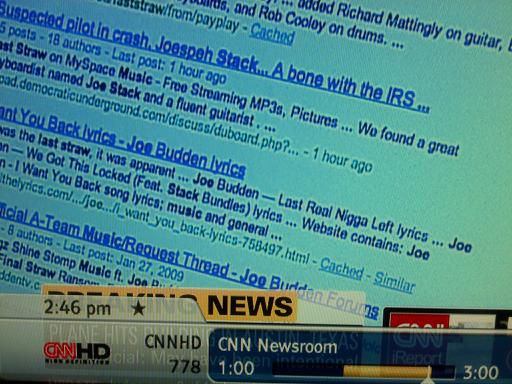
CNN’s really going all out to cover this Austin plane crash story. So all out, in fact, that they’re apparently Googling for anything they can find on the suicide pilot Joseph Andrew Stack. And, yes, of course they’re using to the fullest all the technology in the newsroom, from the shmancy big board to desktop PCs. Sometimes, though, when you’re toggling between windows, you might accidentally broadcast more than you meant to. Like search results that include music from the A-Team and the song title “Last Real Nigga Left.”

The broadcaster realized it and quickly opened a new window, but you can’t be too fast for my DVR.

A similar R-rated misstep took place  last night during NBC’s Olympic coverage. It had just become clear that Shaun White had won the gold, and the cameras were rolling at the top of the hill as the news set in and he prepared for a victory run down the pipe. You could clearly hear White say “I can’t ride right now!” and wonder aloud if he should just ride through the middle. You could also hear his coach, once White decided to showcase his crazy McTwist, tell him to “stomp the shit out of it.”

Sometimes I really love live TV.

Googlers Told to Buzz off; Yahoo Was Ahead of the Curve, Relieved No One Noticed

Pretty much as soon as Google launched Buzz in Gmail, the stings started a-coming. (I knew they would, I just knew it.) Alley Insider did a great “Code Red” timeline of the scramble to un-fuck-up:

February 9 — Google Buzz launches.

February 10 — In a post titled “WARNING: Google Buzz Has A Major Privacy Flaw,” We complain that before you change any settings in Google Buzz, someone could go into your profile and see the people you email and chat with most. Our complaint is that Google forces users to opt-out, rather than opt-in, to exposing this private information publicly.

February 11 — Google updates Buzz to make it easier to opt-out of publicly displaying lists of followers.

February 12We suggest this change doesn’t go far enough.

February 12 — A woman complains that Google automatically set her up to be followed by her abusive ex-husband.

February 13Google goes all the way, replacing an opt-out feature, auto-following, with an opt-in feature, auto-suggesting.

February 16 — Google promises more changes, including a more prominent “mute” option. Says a Google spokesperson, “Some people feel like there is too much noise in the inbox and this is something we are working on better controls for.”

A former Google employee even started a virtual Buzz complaint box.

But what really cracks me up about this whole thing — all the excitement and creeping-out, hemming and (ye)hawing — is that Yahoo started rolling out an automated social wire and status updates on the What’s New page of its mail client months ago (like, August of 09), and no one even noticed. They even posted the latest on the Mail blog on February 5, four days before Buzz exploded:

It’s less invasive than Google’s, as far as I’m concerned (I have email addresses with both), but still pretty, well, fucking stupid. Good thing for Yahoo nobody cares enough to give them a hard time.

[Thanks, Ahs.]

Reader Appreciation: Hope to meet you guys in the afterlife

Thanks to the readers, plural, who found the site by searching
lego sarcophagus.”

See: Video Cool on Own Merits, Not Just Because It References the 80s

Google Game: Things to do other than…

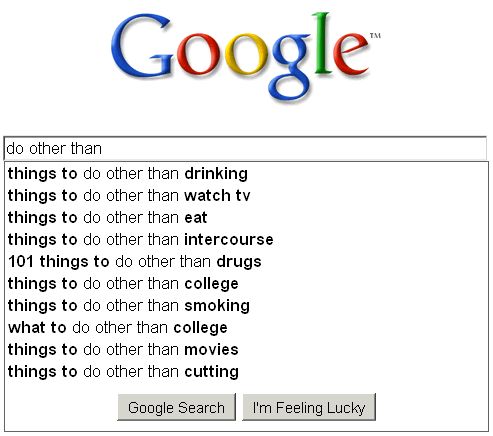
While writing last week’s Google Game post I stumbled upon a gem of a search. From time to time in life you realize that you need a change. You’re on a path someone else laid out for you, or you’re whiling away precious time, or you’re stuck in self-destructive patterns. Naturally, when it’s time to take control an open-ended interweb search is step 1:

Apparently a lot of people are looking for alternative routes after high school, because as far as I can tell these are all elements of the college experience.

Drinking
TV
Eating
Sex
Drugs
Smoking
Movies
Cutting

Yup, sounds about right.