
Category Archives: Gadgeteering

Personal tech, or Things That Go Beep.

iCave

OK, OK. I cave. I have to talk about the iPad. I get it. On my failure to address last week’s most impactful appearance of an important public figure, I’ve not much to say. iPad? My bad. And I reckon this will make me a heretic among my tech brethren (a heretech?), but I pretty much don’t give a hoot. In a word: yawn.

It’ll be interesting to see how the technology is adopted and its release marks a crucial starting point for a new wave of netbook-obliterating, better-than-e-reader devices, but I don’t see an iPhone-esque groundswell/sea change (choose your geometaphor) happening just yet. It’s way better for reading than a Kindle, they say (I haven’t had a hands on), but it’s not like we’re all toting those puppies around. Otherwise, it seems like an oversized iPhone. An oversized iPhone that doesn’t take pictures. Or, you know, make calls. Yet still has a pricey 3G plan with famously spotty service to go along with it.

And as for other sad similarities, how the hell did they let this thing out of the box without multitasking functionality? You know how you can’t play music with the Pandora app on your iPhone while look something up on Google? You won’t be able to do that on the iPad either. Truly idiotic. Hey, check out this cool little ‘puter — it does one thing at a time!

Surely we’ll be revisiting the long-heralded tablet, and in the meantime I’d be remiss if I didn’t jump on the wagon and bring you MadTV’s prescient iPod/iPad spoof circa 2006:

Ralph Waldo Emerson Would Probably Call You a Pussy

Logic leads to advancements, which in turn dictate logic. Why call someone when you can Facebook them? Why scan the street for an address when you can check the location on your iPhone? You could pick up a book on a subject of interest, but instead you’ll search for a few sufficient snippets online. Could you plan a trip without Orbitz or Kayak or Google Maps?

Ralph Waldo Emerson wrote “Self-Reliance” in 1841, praising the strength of the individual, the value of unadulterated opinion, and revealing the folly of blind following. In it Emerson provides a poignant vision of technology’s subtle and subversive shifting of priorities and perceptions. More than a century and a half later it is still a vital reminder that whatever our tools and acquired facilities, we must rely, ultimately, on ourselves.

This passage may as well have been written today, about the Internet and cell phones. The message hasn’t lost a bit of relevance — OK, maybe a bit; Kiwis are, today, largely clothed, I reckon:

Society never advances. It recedes as fast on one side as it gains on the other. It undergoes continual changes; it is barbarous, it is civilized, it is christianized, it is rich, it is scientific; but this change is not amelioration. For every thing that is given something is taken. Society acquires new arts and loses old instincts. What a contrast between the well-clad, reading, writing, thinking American, with a watch, a pencil and a bill of exchange in his pocket, and the naked New Zealander, whose property is a club, a spear, a mat and an undivided twentieth of a shed to sleep under! But compare the health of the two men and you shall see that the white man has lost his aboriginal strength. If the traveller tell us truly, strike the savage with a broad-axe and in a day or two the flesh shall unite and heal as if you struck the blow into soft pitch, and the same blow shall send the white to his grave.

The civilized man has built a coach, but has lost the use of his feet. He is supported on crutches, but lacks so much support of muscle. He has a fine Geneva watch, but he fails of the skill to tell the hour by the sun. A Greenwich nautical almanac he has, and so being sure of the information when he wants it, the man in the street does not know a star in the sky. The solstice he does not observe; the equinox he knows as little; and the whole bright calendar of the year is without a dial in his mind. His note-books impair his memory; his libraries overload his wit; the insurance-office increases the number of accidents; and it may be a question whether machinery does not encumber whether we have not lost by refinements some energy, by a Christianity, entrenched in establishments and forms, some vigor of wild virtue.

We kneel at the altar of information on atrophied legs. Occasionally it would behoove us to get up and walk around.

Trouble Shooting Face Recognition: Profile Yourself (and your friends and family)

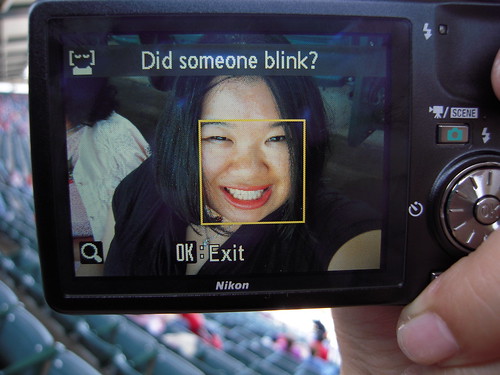
Consumers using webcams with face recognition and digicams with blink-alert have found themselves the victims of racial profiling. Or targeted ignoring-slash-teasing, as it were. Reports Time:

Wang, a Taiwanese-American strategy consultant who goes by the Web handle “jozjozjoz,” thought it was funny that the camera had difficulties figuring out when her family had their eyes open. So she posted a photo [above] of the blink warning on her blog under the title, “Racist Camera! No, I did not blink… I’m just Asian!” The post was picked up by Gizmodo and Boing Boing, and prompted at least one commenter to note, “You would think that Nikon, being a Japanese company, would have designed this with Asian eyes in mind.”

The principle behind face detection is relatively simple, even if the math involved can be complex. Most people have two eyes, eyebrows, a nose and lips – and an algorithm can be trained to look for those common features, or more specifically, their shadows. (For instance, when you take a normal image and heighten the contrast, eye sockets can look like two dark circles.) But even if face detection seems pretty straightforward, the execution isn’t always smooth.

Indeed, just last month, a white employee at an RV dealership in Texas posted a YouTube video showing a black co-worker trying to get the built-in webcam on an HP Pavilion laptop to detect his face and track his movements. The camera zoomed in on the white employee and panned to follow her, but whenever the black employee came into the frame, the webcam stopped dead in its tracks. “I think my blackness is interfering with the computer’s ability to follow me,” the black employee jokingly concludes in the video. “Hewlett-Packard computers are racist.”

Here’s that video. It’s pretty hilarious. Desi seems like a funny guy:

According to Time,  “HP’s lead social-media strategist Tony Welch wrote on a company blog within a week of the video’s posting….The post linked to instructions on adjusting the camera settings, something both Consumer Reports and Laptop Magazine tested successfully in Web videos they put online.”

So that’s the easy answer right there. Don’t change the algorithms or the hardware, just add a step to the set-up process:

  • Please select the ethnicity of the people you most often photograph/record:
    • Caucasian (glarey, wide-eyed)
    • Asian (squinty)
    • Black (shadowy, evasive)
    • Hispanic (kinda like a mix between Asian and Black)

And don’t pull any of that I-hang-out-with-people-of-all-colors shit. Do you want your pictures to come out well, or don’t you? Problem solved.

It separates us from the animals — by 160 characters

While we’re on the subject of kids… Dispatch from a 4th grade science class at the elite Ramaz School in New York City.

Teacher: What are some important things we couldn’t do without opposable thumbs?

Student: Texting!

The ortho Jewish school is tentative on the subject of evolution, but surely regardless of how we got these useful digits it was all part of Hashem’s master plan. And God said unto Abraham, “Text me after sundown.”

Related: Chatspeak Shows No Effect on Spelling, May Improve Haikus.

Console-ation: Video Game Evolution, a Timeline

Video Game Timeline

Click for a graphic time capsule of 40-odd years of videogaming. Who’da thought when Megaman came out talking about the far-off year 20xx we’d actually ever get here?

[from Online Education via Gizmodo]

AT&T to iPhone Users: Poor Service is All Your Fault

Last week AT&T wireless head Ralph de la Vega revealed that dropped calls and spotty service on AT&T’s 3G network isn’t really the company’s fault: It’s yours. For using your phone in the first place.

Betraying a sinister Obamarxist agenda, de la Vega told the Telegraph that 3% of users account for 40% of the network’s data capacity, and that the only way to relieve the crunch is to dissuade the bandwidth bourgeoisie from using their phones so much:

We’re going to try to focus on making sure we give incentives to those small percentages to either reduce or modify their usage so they don’t crowd out the other customers in those same cell sites….What’s driving usage on the network and driving these high usage situations are things like video, or audio that keeps playing around the clock. And so we’ve got to get to those customers and have them recognise that they need to change their pattern, or there will be other things that they are going to have to do to reduce their usage.

Hear that, paying customers? Quit using all those apps the iPhone is specifically designed to provide you. (Ahem, please continue buying them, just don’t, you know, like use them.) Or else.

Or else what? Well, or else you’ll probably have to pay more — in a structured data plan, say — for service that will inevitably stay the same, or get worse. Or you can switch to Verizon, should they ink a deal to sell iPhones when AT&T’s exclusivity agreement ends. Then you can wait until the current self-proclaimed leader in 3G service nationwide finds itself overwhelmed with app-happy screen-touchers and turns the finger back on you.

The LED was only supposed to last for one night… [UPDATED]

Just in time for Hanukkah, the perfect gift for the nerdy Jew in your life. The nerdiest Jew, that is.

The Deluxe LED Menorah kit from Evil Mad Science comes with a pre-programmed microcontroller, battery holder, nine ultrabright LEDs, an alignment guide for the LEDs, and a laser-cut acrylic stand, for $14. Or, for 3 bucks more, get the upgraded kit with white or blue LEDs.

Show them goyim gearheads how real men worship. You cut down a tree? That’s cute. I harnessed photons.

[via Make: Online]

Update Dec 10:

I think we found the ubergeek heeb I alluded to above:

Made from Evil Mad Science kit and Star Trek Pez dispensers. Baruch Uhura.

[via Make: Online]

Robot Salt and Pepper Shakers Bring in the Season(ing)

Add these wind-up robot salt and pepper shakers to my Festivus wish list. They’re robots and toys and food-related all at the same time. I’m in love.

Unfortunately, at 20 Euro/$30 from Britain’s Suck UK I could barely justify the price tag, without additional shipping. Maybe they could just wind ’em up real good for me and point ’em West?

[via Gizmodo]

In Response to AT&T Lawsuit Verizon Employs Classic You’re-Just-Jealous Defense

Verizon did a bang up job with its There’s a Map for That commercials, lambasting AT&T’s shitty nationwide 3G coverage. So the latter, naturally, sued to get the ads off the air, on the grounds that they mislead the viewer into thinking that if you’re not in a 3G zone you can’t get any service at all. Nice try, but no cigar. Engadget this week commented on Verizon legal’s nanny-nanny-boo-boo rejoinder:

Sure, Verizon’s doubled down on the 3G map ads in response to AT&T’s false advertising lawsuit, but eventually the company’s lawyers had to file a response and, well, ain’t nobody backing down in this one. Here’s the freaking introduction:

AT&T did not file this lawsuit because Verizon’s “There’s A Map For That” advertisements are untrue; AT&T sued because Verizon’s ads are true and the truth hurts.

Yeah. It’s gonna be like that. Verizon goes on to argue that even AT&T concedes the maps are accurate, and that pulling any of the ads off the air without proof that they’re misleading consumers would be unfair, and that at the very least both parties need time to investigate further. Honestly? We’ve read it over a couple times now and while the legal arguments are certainly interesting, it’s hard not to get the impression that Verizon drafted this response with publication in mind — check out this quote:

In the final analysis, AT&T seeks emergency relief because Verizon’s side-by-side, apples-to-apples comparison of its own 3G coverage with AT&T’s confirms what the marketplace has been saying for months: AT&T failed to invest adequately in the necessary infrastructure to expand its 3G coverage to support its growth in smartphone business, and the usefulness of its service to smartphone users has suffered accordingly.

See what we mean?

Booya. Pretty entertaining stuff. Maybe they should put their lawyers on their next ad campaign. Of course, their money might be better spent making phones that can utilize Verizon’s extensive 3G coverage, without sucking. Cue the Droid.

Adorobots

Hi. I rock.

These incredible, covet-able robots are all made from retired electronics. I’m hardly driven enough to even bring my old cell phone to the place down the street to recycle it, let alone remotely creative or dexterous enough to fashion it into an awesomely adorable figurine the way some artsy modders do:

See more robo-radness at hack n mod. And, watch this slideshow of “sparebots” made from capacitors, diodes, resistors, LEDs and bits of wire made by some tinkerer called Lenny. I’m gaga for these guys. Lenny’s masterful photography skills don’t hurt none. I’ll have some of that too, please.