Category Archives: Write and Wrong

Language and (mis)usage.

Edit or Get off the Pot [UPDATED]

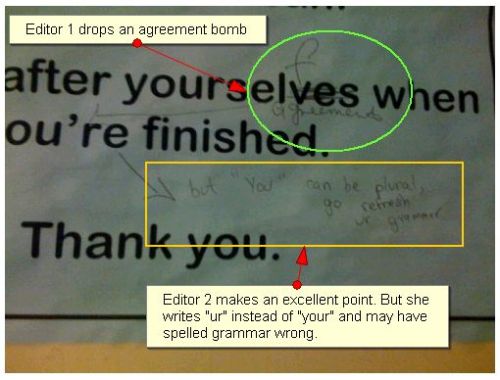
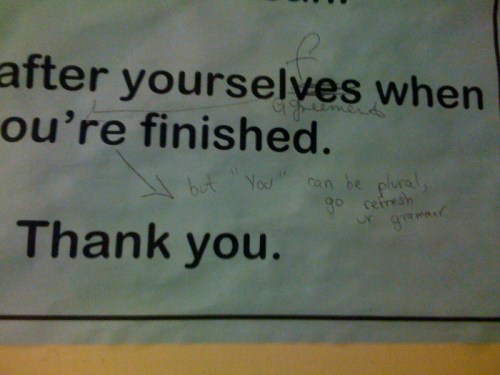
Attention students: the editing bug is going around. Thanks to Kim for sending this shot taken of a sign in a ladies’ room at Downstate Medical School.

photo

The play by play as I see it:

photo annotatedA for effort, girls. The first step toward proper grammar is acknowledging that you have a problem. If med students in the middle of exams have time to think about usage — while on the potty, to boot! — maybe there’s hope for the rest of us.

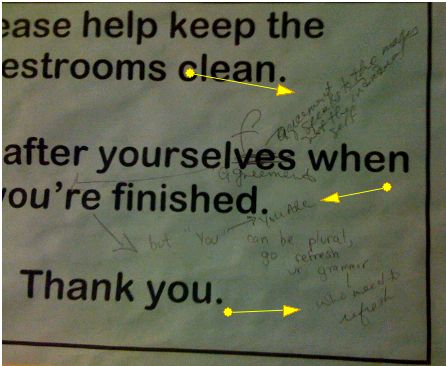
Update: September 29. The battle rages on….

photo(2) annotated
This could get ugly.

Unhappy On On Langage On Un-Language

This weekend’s New York Times Magazine On Language column, written by Ben Zimmer (in for Sir Safire) looks at what Zimmer calls “the age of undoing,” the preponderance of backformed words created by tacking a convenient un- to the front of everything.

The article begins:

“What’s done cannot be undone,” moaned Lady Macbeth in her famous sleepwalking scene. If she woke up in the 21st century, she would be pleased to discover that whatever can be done can be undone, too.

Or perhaps it just seems that way in the new social spaces we are carving for ourselves online. On popular Web sites devoted to social networking, innovative verbs have been springing up to describe equally innovative forms of interaction: you can friend someone on Facebook; follow a fellow user on Twitter; or favorite a video on YouTube. Change your mind? You can just as easily unfriend, unfollow or unfavorite with a click of the mouse.

The recent un- trend has also seeped into the world of advertising. KFC is marketing its new Kentucky Grilled Chicken with the tagline “UNthink: Taste the UNfried Side of KFC.” The cellphone company MetroPCS challenges you to “Unlimit Yourself,” while its competitor Boost Mobile wants you to get “UNoverage’D” and “UNcontract’D” (ridding yourself of burdensome overage fees and contracts). Even victims of the financial downturn can seek solace in un-: ABC broadcast a special report in May telling viewers how to get “Un-Broke.”

It goes on to trace the un-ing of words back to some linguistic genesis, one rooted largely in the electronic world. Forsooth, there once was a time when the “Undo” command was novel. But what interests me more than their digital-etymological rise are the cultural connotations of these words, and what they signify beyond their definitions.

Take, first, Zimmer’s advertising and ABC examples: UNfried, UNlimit, UNoverage’D, UNcontract’D and Un-Broke. What I see here is more than clever marketing, but the display of a pervading sense of dissatisfaction. Typically, branding serves consumers (that’s us) with aspirational images. Beer will make you cool and popular, makeup will make you beautiful, etcetera, ad infinitum. Buy this, become better. But these un- slogans are not about becoming what you want; they’re about un-becoming what you are and wish you weren’t.

Continue reading

Keeps Your Hands Free to Pen Shoddy Copy!

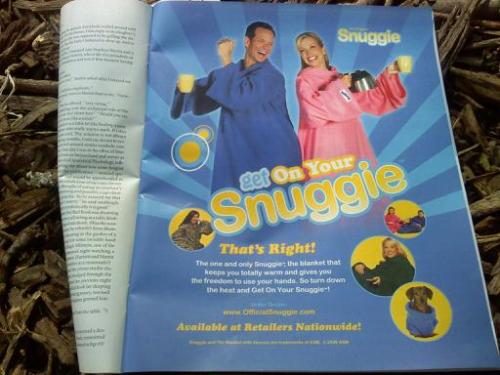
Forget the hype. I don’t want to wax philosophical on the troubling societal implications of Snuggie’s ascendancy to national renown. I’d just like to take a quick red-pen look at this magazine ad:

downsized_0920091514

I’m confused. Is this, perhaps, meant to say “Get Your Snuggie On”? Shouldn’t it? I’m just sayin.

I mean, those people look like they’re getting their Snuggie(s) on, don’t they? (Whatever that means.) I guess it could just be telling the reader to put on his Snuggie like a mother telling a kid to put on his coat. Though my mom probably would have said, “get your coat on” rather than “get on your coat.” Maybe it’s an instruction to get onto your Snuggie. Sit on it. Mount it. Ew, I’m done with this line of reasoning.

So, is this clever, or just awkward? Well if that isn’t the crux of the Snuggie itself.

Punctuation Mark’s Aren’t Toy’s

In light of the recent post on rules of writing, how about some real life examples of what not to do?

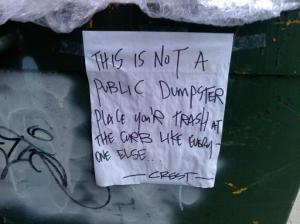
We’ve all seen our fair share of misplaced apostrophes hanging around in plural words, like this one, here, on a note in my apartment building:

apologies if you see these words instead of a picture. wordpress is fucking with us all.

(I see another resident has his eyes on proofreading, a kindred word nerd in Alphabet City.) But this one spotted in Williamburg, BK, is truly creative in its positioning:

downsized 0916091729

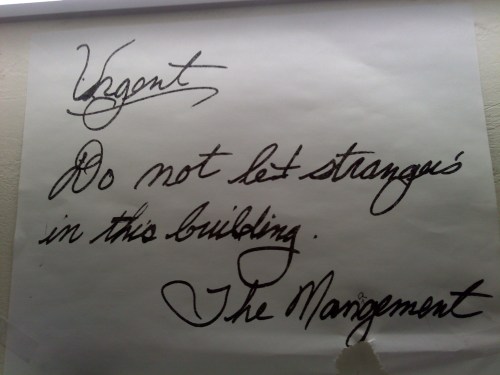
I’ve seen “your” for “you’re” and vice versa. But the “you’r” iteration is new to me. Clever, no?

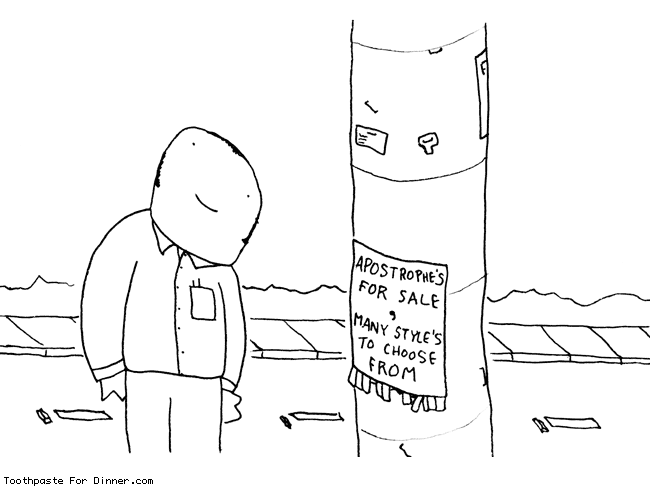
Now allow me to pass the mic to Drew, author of my favorite web comic, toothpastefordinner.com

(This ones a shirt!)

www.toothpastefordinner.com

The Punisher

serena-williams-yelling

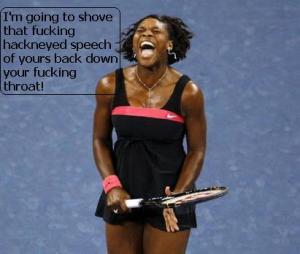
In a pun-soaked teaser to an update on the Serena Williams debacle from over the weekend, CNN’s Kyra Phillips just said:

Tennis superstar shows contempt of court. Now Serena Williams is going to have to pay for her verbal volley. Was she over the line?

I know how tempting it can be. I could pun the pants right off ya. But really, show a little restraint.

Maybe this would be a good time to review some basic writing rules. This list, in various forms, has made the writer rounds for years; certainly any journalist has been read the liturgy once or twice. Here’s a good version of it:

1.       Verbs has to agree with their subjects.

2.       Prepositions are not words to end sentences with.

3.       And don’t start a sentence with a conjunction.

4.       It is wrong to ever split an infinitive.

5.       Avoid clichés like the plague. (They’re old hat)

6.       Also, always avoid annoying alliteration.

7.       Be more or less specific.

8.       Parenthetical remarks (however relevant) are (usually) unnecessary.

9.       No sentence fragments.

10.     Contractions aren’t necessary and shouldn’t be used.

11.     One should never generalise.

12.     Don’t use no double negatives.

13.     Eschew ampersands & abbreviations, etc.

14.     Eliminate commas, that are, not necessary.

15.     Never use a big word when a diminutive one would suffice.

16.     Kill all exclamation marks!!!

17.     Use words correctly, irregardless of how others use them.

18.     Use the apostrophe in it’s proper place and omit it when its not needed.

19.     Puns are for children, not for groan people.

20.     Proofread carefully to see if you any words out.

Note, the Unhappy Mediator is a dedicated subscriber to usage rules — but also believes that (pardon the cliche (pardon the cliche)) rules are made to be broken. That is, when I’m doing the breaking.

What’s in a name?

Better question this morning might be: what’s in a Hippo?

Aphrodite, as it turns out.

I know it’s silly, but I just couldn’t help but laugh at this headline from one of my favorite nerd-pubs, Eureakalert science newswire:

Figurines of Aphrodite from the era of the Roman Empire discovered in Hippos

In Hippos!

I don’t even really care where Hippos is, or why this is news. I just want to picture the grinning ‘potamuses/’potami and wonder how the intrepid discoverers got in there in the first place.

Onion Causes Tears in Bangladesh

“We’ve since learned that the fun site runs false and juicy reports based on a historic incident.” So went the spot-on encapsulation of the Onion‘s editorial mission, as summarized by Bangladesh’s Daily Manabzamin tabloid newspaper. The revelation was part of a correction for reprinting an Onion story that reported Neil Armstrong had been convinced the Moon landing was a hoax.
Indeed a sad moment in global journalism. Ironically, it sounds like an Onion headline itself:

Bangladeshi Tabloid Reprints False Story, Gives the
Onion Fleeting Sense of Credibility

My first reaction to the story (via BBC News) was a hearty “Oh, my.” Then it just became funny.

But overall, I’m going to go with troubling. Thing is, true journalism and entertainment have been colluding for a while — The Daily Show, naturally; Smoking Gun; blogs in general, etc. etc. — but as they become more and more dangerously intertwined we should be becoming more and more vigilant. And we’re not. Quick example: I’d like to think that the recent news that Wikipedia is going to control the editing of the bios of living notables is a sign that we’re beginning to embrace the notion of accountability. But more likely it’s just a result of some PR team raising a stink about embarrassing facts making it into their boss’s page, and making their lives hell. People want the scoop now and they’ll take the apologies later.

I guess the real takeaway here is: If you’re going to read Bangladeshi tabloids, do so with a critical eye.

Lingo for Losers

Look, jargon happens. Every industry or hobby comes with its own unique lexicon. Sometimes the terms make communicating a point quicker or easier (you work in M&A? That’s cool.). Sometimes they’re more like secret code (journalists and their “ledes”). But too often all they do is annoy whoever is listening.

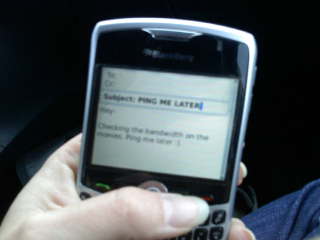
Recently a public relations person, or flack, as we often call them — at least it has the semantic bonus of being slightly pejorative — asked me if I had any “bandwidth” on my deadline. I actually had to call a PR friend to ask her what the hell that means. Turns out most flacks are already over the term, which means capacity, and which this woman wasn’t even using properly. She evidently wanted to know if I had any flexibility, if I could push my deadline back. Really, it’s a simple question. Let’s keep it that way.

Here’s another surefire way to sound like a jackass: say “monies.” Hunters don’t shoot deers, you wouldn’t order fried rices. Just give me my money.

Oh, and no, I will not PING you later.

0826091622

Shall we get a list going? What are some of your most hated bits of jargon?

Fun with Translations: Jesus is the Man

Who da man? God da man.

0813092310

Jesus rules on 4th Ave in Brooklyn

Happy Sunday, folks.

Emoticontinental Divide

Well if we can’t trust emoticons to express how we feel, who can we trust?

A study published in Current Biology reveals that Easterners and Westerners use different facial cues to recognize emotion. While we scan all features, Asians tend to focus on the eyes, which can lead to cultural confusion, particularly when interpreting emotions like fear, surprise, disgust and anger. (NB if you ever see me, best to assume I’m displaying all four.)

Interestingly, this accounts for why Asians often opt for different emoticons than we do. Here, the mouth tends to do the heavy lifting, whereas in the East there are myriad variations in the eyes. To wit:

Western Happy  : )

Eastern Happy  ^_^

Western Sad  : (

Eastern Sad  ;_; (tears! so clever!)

Western Surprised  :0

Eastern Surprised  O_o

You get the picture. Now this is the part where I make an unseemly joke about their eyes never actually being open wide. What’s the agreed-upon emoticon for Don’t Hit Me?