Tyler Perry’s Next Bad Thing

Oh, Tyler Perry, you make it too damn easy. So his new movie is coming out next month. Its title speaks volumes. Because it’s volumes fucking long. I Can Do Bad All By Myself. Pretty catchy, right?

So what’s the perfect website for a movie with a title that’s seven words long? ICanDoBadAllByMyselfMovie.com? No. It’s so much better than that.

ICanDoBadMovie.com

Yes, Mr. Perry, yes you can. You can do bad movie. You seem to do bad movie every four to six weeks. Most people can’t even get a bad haircut with that frequency.

To be clear, I haven’t seen any preview screening of this highly anticipated film. But I have read the synopsis. And it’s brilliantly dreadful. Try to keep up.

When Madea catches sixteen-year-old Jennifer and her two younger brothers looting her home, she decides to take matters into her own hands and delivers the young delinquents to the only relative they have: their aunt April. A heavy-drinking nightclub singer who lives off of Raymond, her married boyfriend, April wants nothing to do with the kids. But her attitude begins to change when Sandino, a handsome Mexican immigrant looking for work, moves into April’s basement room. Making amends for his own troubled past, Sandino challenges April to open her heart. And April soon realizes she must make the biggest choice of her life: between her old ways with Raymond and the new possibilities of family, faith … and even true love.

If you dare to IMDb, be aware that this is the second T-Per release called I Can Do Bad All By Myself. In 2002 a DVD came out of the original stage version of ICDBABM. Don’t worry, apparently you can see both and get two completely different stories. At least he kept the ellipses…

Playwright Tyler Perry plays Madea, the matriarch in this filmed version of Perry’s hit play. Madea’s niece, Vianne, has been handed a curve ball by life: Her husband seems ready to flee the marriage, and little does she know that he’s actually seeing her sister. When Madea falls ill, the secrets surface, tearing everyone apart. Vianne’s faith tells her to accept the chain of events and move on, but letting go isn’t easy. …

Seriously, Tyler Perry, you’re just making it way too easy. It’s not even fun anymore.

Continue reading

No One Knows What It’s Like (To Be the Ad Man)

Good story in the Times Sunday Business section on Microsoft’s marketing efforts (versus Apple’s). I use a PC, I love John Hodgman, and I can’t stand Justin Long, so the cleverness and execution of Stevie J’s I’m a Mac/I’m a PC spots has always felt like something of a personal affront. Interesting how deeply the caricature applies, unintended as it may be; Apple’s based its corporate culture on progressive design and creativity, while the real MSFT really doesn’t get it. But it’s starting to (excerpt):

There were also cultural issues at Microsoft when it came to advertising. On Madison Avenue, they say that the more hands that touch an advertisement, the worse it becomes. Microsoft felt differently. “They thought the more people saw it and gave an opinion, the better it would be,” Mr. Musser said. “That’s how you develop software. It’s not how you develop great creative.”

So Ms. Mathews tried to change things. She set up a nine-member task force to figure out a marketing strategy and keep meddlers at arm’s length.

In February 2008, Microsoft picked Crispin Porter. At the agency, Mr. Reilly was initially apprehensive. He didn’t even own a PC; he had an ultraslim MacBook Air. (He has since bought himself two PCs — a Sony Vaio and a Lenovo ThinkPad.)

The adman also wondered whether Microsoft was ready for a Crispin campaign. Mr. Reilly himself oversees the agency’s irreverent work for Burger King, aimed at young men hungering for menu items like the Triple Whopper.

He wanted to come up with a campaign that would redefine Windows, and he counseled against ads that attacked Apple. Then he changed his tune. Last summer in Apple ads, Mr. Hodgman’s PC character morphed into a personification of Microsoft itself. PC was haunted by problems with Vista. He took up yoga to calm his nerves, only to discover that his teacher was on edge because Vista wreaked havoc on her billing system. PC tried to find peace by creating a line of herbal teas with names like “Crashy-Time Camomile” and “Raspberry Restart.”

“As the tone of their campaign became more and more negative, we were like, ‘We gotta do something,’ ” Mr. Reilly said. “That’s where the whole notion of ‘I’m a PC’ and putting a face on our users came about. We have a billion users. That’s who our cast is, whereas Apple is just two fictitious characters.”

Microsoft recruited influential Windows fans like the “Desperate Housewives” star Eva Longoria. “I feel bad about the little PC guy,” she said this month. “He is always getting beaten up.” It also brought in some who would appeal to niche audiences, like the Pittsburgh mash-up D.J. Gregg Gillis, who is better known as Girl Talk.

When Mr. Ballmer finally saw the ads in September, he congratulated Ms. Mathews and gave her a high-five. Then, Ms. Mathews says, he started shouting, “I’m a PC!”

As the “I’m a PC” ads with Mr. Siler replaced them two weeks later, Apple’s “Get a Mac” spots disappeared. Microsoft doesn’t think that was a coincidence. When PC and Mac reappeared, it was in the advertising that criticized Microsoft as spending on ads rather than on Vista.

Microsoft thought that it had scored a point. “You’ve got to look at that and say, ‘You are not advertising to consumers; you’re advertising to the Microsoft marketing department,’ ” Ms. Mathews says. “I just admit that did bring a smile to my face.”

Emboldened, Microsoft continued its barrages. In February, it unveiled its “Rookies” ads, arguing that PCs are so easy to use that even Kylie, an adorable 4 1/2-year old, could upload a picture of her goldfish, Dorothy, onto her PC and e-mail it to her relatives. You want to make fun of Kylie, Apple? Microsoft and Crispin dare you to try it.

The next month, Microsoft deployed its “Laptop Hunters” ads. They clearly moved the needle in Microsoft’s favor. Ted Marzilli, a managing director of BrandIndex, a company that tracks consumer perceptions, said that at the beginning of the year, adults thought Apple offered more value than Microsoft. In May, however, Microsoft closed the gap in the firm’s surveys. “Apple took a hit,” Mr. Marzilli said. “Since then, they have been neck and neck.”

In June, Microsoft felt that it had more reason to gloat. The chief operating officer, B. Kevin Turner, says he got a call from an Apple lawyer who asked him to change the ads because Apple was lowering its prices by $100. “I did cartwheels down the hallway,” Mr. Turner subsequently boasted in speech at a New Orleans conference.

Then Apple announced its second-quarter rebound. And for some analysts, it seemed like game over. “The reality is that Apple’s business has been impacted by the overall economy, not by Microsoft’s campaign,” said Gene Munster, senior research analyst at Piper Jaffray. “Those ‘What can I get for 1,000 bucks’ ads? That was a clever campaign. But it never really caught on. If you compare it to ‘Get a Mac,’ it didn’t even register.”

And yet Apple keeps responding. On Friday, it released its Snow Leopard operating system a month ahead of schedule, accompanied by a new round of “Get a Mac” ads. One involves a red-headed woman who is clearly intended to resemble Microsoft’s Lauren. PC introduces her to his suave friend, a top-of-the-line model played by Patrick Warburton, who was David Puddy on “Seinfeld.” She declines to buy a Windows machine when they can’t promise that she won’t have virus woes.

Microsoft, however, has found it enjoys mixing it up with Apple on the airwaves. In July, Mr. Ballmer told analysts that Crispin’s work had been “quite effective.” He promised that Microsoft would continue investing heavily in Windows marketing. “We didn’t do that three, four, five, six years ago,” he added.

Funny the way that the Mac ads have created a reverse David and Goliath. I find myself pulling for Microsoft, the long-time market leader. Reckon it doesn’t help my bias that real life Mac users get a little Justin Long-ish themselves from time to time: can’t find a document, or can’t get a signal? Wouldn’t be a problem if you had a MacBook or an iPhone. psha.

Typically it’s the individual manufacturers that do the advertising — Dude, you’re getting a Dell! — but right now Microsoft is taking the creative challenge personally. True, their ads don’t have the style, panache, or comic value of the Mac commercials, but it’s kind of fun to watch the back and forth.

****

On a separated but related note, I love this Intel ad:

Could do without the a capella bingbong jingle, though.

E(nnui)Mail

MELANCHOLY WALLPAPER BWhen you care to send the very true, check out Melancholy Greetings. In the vein of the biting, often hilarious canned salutations of someecards.com, Melancholy Greetings offers punchy one-liners that punch you right where it hurts the most, wherever that may be. Take, for instance, the basic category:

general malaise

Are you having trouble articulating that vaguely nonplussed, out-of-sorts feeling that dogs your waking hours? Perhaps one of these all-purpose, melancholy-inspired cards will do the trick.

But wait, get this: they’re actual, physical cards. Remember those? Go crazy, go analog! Pick up a card (I found them at Barnes & Noble), pick up a pen, and pick a friend to dazzle with your magic-like Pony Express abilities. It’s OK if you need to facebook him for his address.

Word Games Are for Fruits

First there was Bananagrams: a banana-shaped satchel full of lettered tiles for an on-the-go word-building activity. The perfect travel game for word nerds who prefer to spend their vacations in the shade debating the ruling on the legitimacy of Latin idioms, or some arcane Elizabethan slang.

My friends got me into the game, but I have never been able to  really get behind the name. I find the correlation between bananas and anagrams tenuous at best, and as such, unsatisfactory. Ok, they share some letters, but what do bananas and anagrams really have to do with each other? Why not bandanagrams, packaged in a red paisley bindle? Or flanagrams, complemented by a Spanish custard dessert? It feels like a stretch.

Anyway, Bananagrams’ utter goofiness notwithstanding, it’s a pretty good game. But imagine my surprise today when I notice a new product on the portable word game market: Scrabble Apple. Apparently unwilling to let some no-name British wannabes horn in on the legacy they created, the honchos at Scrabble came up with their own fruity retort. Scrabble Apple. Real original, guys.

Well, once again, I’m not sold on the correlation. You need some serious license to rhyme Scrabble with apple, and I can’t see any other logical argument for putting the two together. You know, except that Hasbro will be damned if a saggy banana sack is going to cut into their market share.

Note, though, that Scrab-Apple just came out, while Bananagrams have been in the US since at least 2007, which means it took their team a full two years to launch this juicy rejoinder. I reckon that time was spent on intense sales research that revealed it really is the palatable product design that makes Bananagrams so appealing.

Of course, we know that consumers are, for the most part, suggestible morons, and that brand managers are formulaic conformist sluts. What troubles me is that I’m detecting a hostile subtextual message:

People who play word games are fruits.

If we’re such a bunch of nerdy gaylords, don’t think we’re not going to notice the not-so-subtle commentary. What’s next? Boggle Avocado… Balderdates… How about some Taboo-leh? That’s a pretty fruity victual.  Dish it out, world. We’ll take it, rearrange it, and triple word score your ass.

Lingo for Losers

Look, jargon happens. Every industry or hobby comes with its own unique lexicon. Sometimes the terms make communicating a point quicker or easier (you work in M&A? That’s cool.). Sometimes they’re more like secret code (journalists and their “ledes”). But too often all they do is annoy whoever is listening.

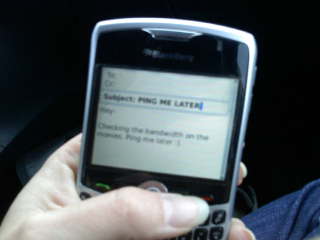
Recently a public relations person, or flack, as we often call them — at least it has the semantic bonus of being slightly pejorative — asked me if I had any “bandwidth” on my deadline. I actually had to call a PR friend to ask her what the hell that means. Turns out most flacks are already over the term, which means capacity, and which this woman wasn’t even using properly. She evidently wanted to know if I had any flexibility, if I could push my deadline back. Really, it’s a simple question. Let’s keep it that way.

Here’s another surefire way to sound like a jackass: say “monies.” Hunters don’t shoot deers, you wouldn’t order fried rices. Just give me my money.

Oh, and no, I will not PING you later.

0826091622

Shall we get a list going? What are some of your most hated bits of jargon?

Introducing The Google Game

google_logoGoogle is smart. And Google knows what you’re thinking. Soon you’ll be able to let Google do the thinking for you, but for now all it can do is help.

If you’re searching for Girl Drink Drunk, the classically hilarious Kids in the Hall sketch, it guesses your goal in two words. Or say you query “The Redhead” (in quest of Frank Bruni’s last review), Google lets you know that Google knows you’re referring to the restaurant in NYC.

Despite the eerie sensation of encroaching omniscience, Google’s search suggestions are still little more than a reflection of what we, conductors of the rumbling search engine, most often seek. The site itself explains – vaguely – that “as you type, Google Suggest communicates with Google and comes back with the suggestions we show….suggestions are drawn from…searches done by users all over the world, sites in our search index, and ads in our advertising network.” If you’re signed into your Google account and/or have your web history enabled, it also factors in your own sordid search past.

So what are we searching for? To answer the question I bring you the first weekly installment of the Google Game.  Easier than Go Fish, and much more revealing: I type a word or incomplete phrase into the Google search bar and report back Google’s suggestions. Then we ruminate on our collective shame.

After the jump, Google Game Round 1.

Continue reading

Video Cool on Own Merits, Not Just Because It References the 80s

“8-Bit Trip” is leagues better than your average multimedia genuflection to 80s pop culture.  Ignore the guy’s too-ironic-for-school ensemble in the first few seconds and enjoy one of history’s most impressive Lego feats (1,500 hours of work, according to the artists). If you like any or all of the following — Lego, stop animation, Nintendo, Atari, synth, awesome — and are not epileptic, you absolutely must check out this video homage to a bygone era by composer Daniel Larsson and animator Tomas Redigh, together Sweden’s Rymdreglage.

The ninjas Kung Fu fighters freakin’ kill me. And the new perspective on Pac-Man? Enlightened, enlightening.

But my number one takeaway: I no longer want to donate my body to science. Please entomb me in a Manda-shaped Lego sarcophagus.

Fun with Translations: Jesus is the Man

Who da man? God da man.

0813092310

Jesus rules on 4th Ave in Brooklyn

Happy Sunday, folks.

My Kind of Mixed Media

It’s happened to each of us at some point. You’re walking down the street, soda in one hand, cup of fried chicken in the other, and you realize you lack the dexterity to pop the next piece of poultry in your mouth, and the straw is too thin for hoovering even the sveltest morsel. (You tried.) Fret no more, friends, BBQ Chicken hits St. Marks with an elegant one-cup solution.

Behold. The combo cup-o-soda-cup-o-chicken. The perfect snack for:

* The Blackberry-toting mover/shaker
* The I-carry-my-own-shopping-bag conservationist
* The one-handed

downsized 0820091513

A startling example of how Korean ingenuity is pushing the limits of fast food technology, this two-timing vessel has a lower chamber for your cola and a recessed lid that serves as a convenient receptacle for breaded – and unnaturally cubic – chicken nuggets.

As brilliant as the concept is the marketing approach. A straightforward product shot, which says, “This needs no explanation.” One has to wonder how many 2 girls 1 cup jokes were made in the copywriting process.

Spin, Store a Yarn

Saw this classified posting on mediabistro.com a journalism/media website this morning:

Yarn Coordinator job in New York, NY at SoHo Publishing Company

I’ve had plenty of editors say I need to spin a yarn, but I’ve never been in the position of having to coordinate one. I tried to imagine what that job would be like. You’d sit in your cubicle eight hours a day looking musingly up and to the right, conjuring tales. When one comes to you, you center yourself in front of the computer and enter it into a database. Or better yet, you write each idea down, slip it into a canister, and arrange it on a towering wall of cubbies. Train robbery? Transportation column, row crime.

Just when I was ready to file my own yarn under “I” for Ideal Job, I clicked on the description:

Publisher of consumer knitting publications seeks a passionate needleworker with excellent verbal and written communications skills…

Oh, how disappointingly… literal. Still, I liked the idea of looking for a “passionate needleworker” with “excellent verbal” skills and read on. Here are the choicest of the job requirements:

  • writing yarn updates and other yarn-related copy for magazines
  • answering yarn-related consumer mail
  • Must be extremely well organized and able to juggle multiple projects with aplomb

Do let us be clear, all updates, copy and mail you would be responsible will be YARN-RELATED. Juggling ability preferred. Ok, that’s a pretty common way of saying “multitask,” but to me, it’s hilarious juxtaposed with yarn, something one could literally juggle. C’mon, that’s funny.

By the way, this job pays “under $35,000” a year. And I’m not qualified for it.