Monthly Archives: January 2010

Reader Appreciation: Really, what are the odds?

Thanks to the reader who found the site by searching
mountain dew mead.”

See: Mead, M’Lady? Prithee, Mountain Dew

The Triumphant Rise of Urology, and Other Nerdtastic Trendlines

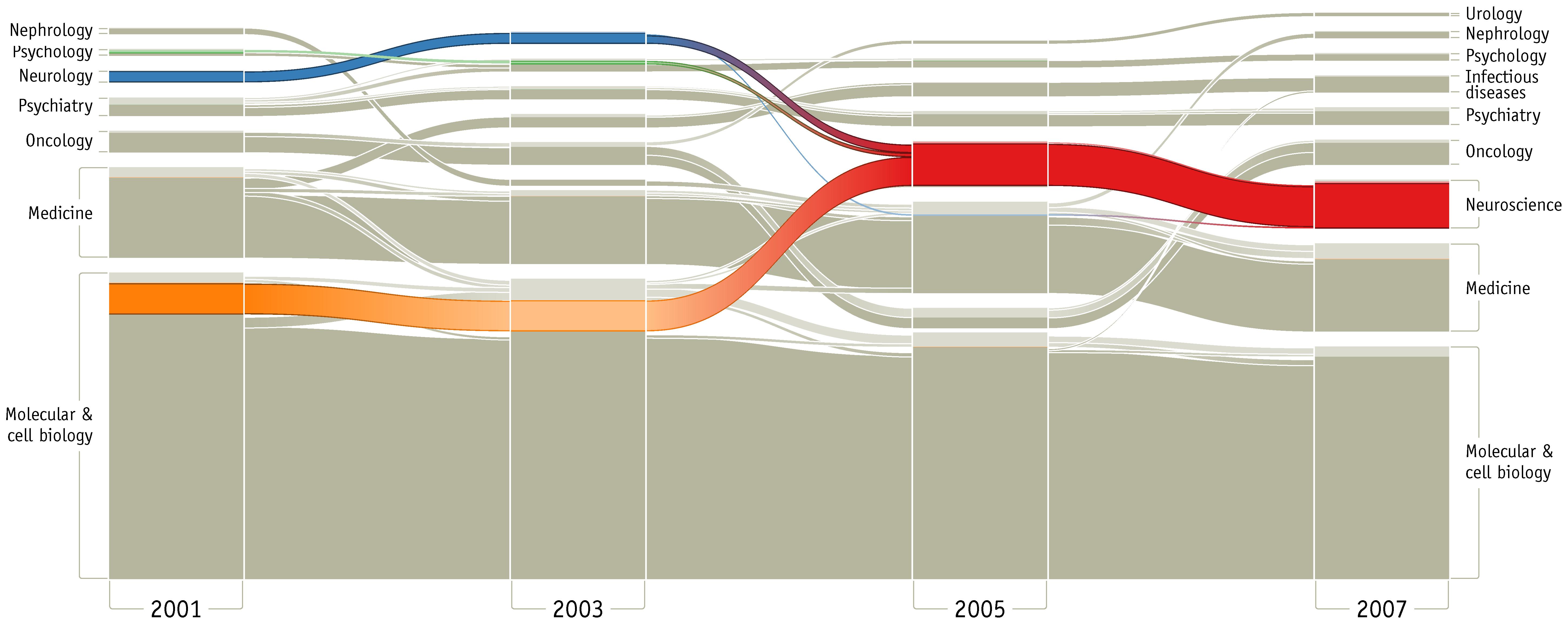
Analyzing 35 million citations from 7,000 journals, researchers at the University of Washington and the Santa Fe Institute have traced and plotted changes and fluctuations in the prevalence of various fields of scientific study over the past decade.

Among the most notable observations are the branching of broad study areas into more specialized, standalone disciplines, and the emergence of newly defined fields, such as neuroscience (which was, indeed, an interdisciplinary concentration when I majored in it — or something like it — as an undergraduate in the nascent millennium):

The alluvial diagram illustrates, for example, how over the years 2001–2005, urology gradually splits off from oncology and how the field of infectious diseases becomes a unique discipline, instead of a subset of medicine, in 2003. But these changes are just two of many over this period. In the same diagram, we also highlight the biggest structural change in scientific citation patterns over the past decade: the transformation of neuroscience from interdisciplinary specialty to a mature and stand-alone discipline, comparable to physics or chemistry, economics or law, molecular biology or medicine.

Also worth remarking: the conspicuous lack of progress in the field of making graphs that don’t give you a migraine.

(Published in PLoS ONE.)

Bulk Mail Bards

Not so long ago we looked at an awesome piece of spam mail that seemed acutely aimed at the Unhappy Mediator’s proclivity for the scientific. Well, yesterday I found myself once again immersed in my junk folder, and the language lover in me was struck by the inventive word choice and unusual rhythms of a handful of emails. They were downright… poetic. Indeed, the subject heads and first lines seemed to form perfect lyrical couplets. Below, a selection that would give even Chaucer a chubby. Shake William’s spear. Thaw Robert’s Frost. Make ee cummings. I’ll stop, I’ll stop.

Sad truth on your size
Potion for heroic banging

Avoid bed-loser’s fate
Love-skill increment

The night is a time to have fun in bed. Make this fun lasting!
Best girl-digging skills

Need your knob up?
Any girl will stay with you

I got a lot about you
In shape for making it?

Harder banging is real
Exploding ardor every night

Want to see her happy tears?
Don’t pay for delivery

High amour degree
Shoot your gin into her vagina

10 seconds and it’s up and firm
Confirm on receiving

Google Game: Quotes

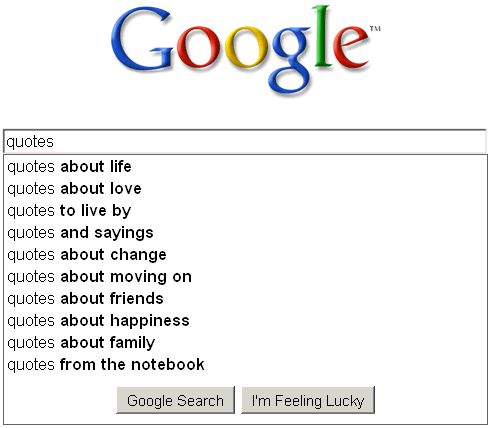
Nuptials. Breakups. Friendship. New baby, job, home, direction. When something profound happens we look for words worthy of the occasion. Then we realize that we have no idea what to say. But someone else must. Aha! Quote a famous person! Someone smart and eloquent and insightful and not you. To the internet!

Looks about right. Life, love, moving on, happiness… The Notebook? Geesh. When I found that I took a breather, then redid the same search and found a rather hilarious surprise substitution…

Continue reading

Ralph Waldo Emerson Would Probably Call You a Pussy

Logic leads to advancements, which in turn dictate logic. Why call someone when you can Facebook them? Why scan the street for an address when you can check the location on your iPhone? You could pick up a book on a subject of interest, but instead you’ll search for a few sufficient snippets online. Could you plan a trip without Orbitz or Kayak or Google Maps?

Ralph Waldo Emerson wrote “Self-Reliance” in 1841, praising the strength of the individual, the value of unadulterated opinion, and revealing the folly of blind following. In it Emerson provides a poignant vision of technology’s subtle and subversive shifting of priorities and perceptions. More than a century and a half later it is still a vital reminder that whatever our tools and acquired facilities, we must rely, ultimately, on ourselves.

This passage may as well have been written today, about the Internet and cell phones. The message hasn’t lost a bit of relevance — OK, maybe a bit; Kiwis are, today, largely clothed, I reckon:

Society never advances. It recedes as fast on one side as it gains on the other. It undergoes continual changes; it is barbarous, it is civilized, it is christianized, it is rich, it is scientific; but this change is not amelioration. For every thing that is given something is taken. Society acquires new arts and loses old instincts. What a contrast between the well-clad, reading, writing, thinking American, with a watch, a pencil and a bill of exchange in his pocket, and the naked New Zealander, whose property is a club, a spear, a mat and an undivided twentieth of a shed to sleep under! But compare the health of the two men and you shall see that the white man has lost his aboriginal strength. If the traveller tell us truly, strike the savage with a broad-axe and in a day or two the flesh shall unite and heal as if you struck the blow into soft pitch, and the same blow shall send the white to his grave.

The civilized man has built a coach, but has lost the use of his feet. He is supported on crutches, but lacks so much support of muscle. He has a fine Geneva watch, but he fails of the skill to tell the hour by the sun. A Greenwich nautical almanac he has, and so being sure of the information when he wants it, the man in the street does not know a star in the sky. The solstice he does not observe; the equinox he knows as little; and the whole bright calendar of the year is without a dial in his mind. His note-books impair his memory; his libraries overload his wit; the insurance-office increases the number of accidents; and it may be a question whether machinery does not encumber whether we have not lost by refinements some energy, by a Christianity, entrenched in establishments and forms, some vigor of wild virtue.

We kneel at the altar of information on atrophied legs. Occasionally it would behoove us to get up and walk around.


Trouble Shooting Face Recognition: Profile Yourself (and your friends and family)

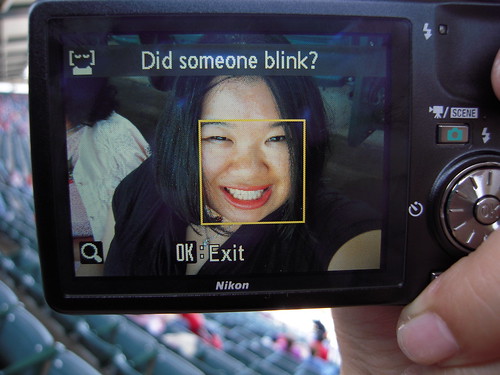
Consumers using webcams with face recognition and digicams with blink-alert have found themselves the victims of racial profiling. Or targeted ignoring-slash-teasing, as it were. Reports Time:

Wang, a Taiwanese-American strategy consultant who goes by the Web handle “jozjozjoz,” thought it was funny that the camera had difficulties figuring out when her family had their eyes open. So she posted a photo [above] of the blink warning on her blog under the title, “Racist Camera! No, I did not blink… I’m just Asian!” The post was picked up by Gizmodo and Boing Boing, and prompted at least one commenter to note, “You would think that Nikon, being a Japanese company, would have designed this with Asian eyes in mind.”

The principle behind face detection is relatively simple, even if the math involved can be complex. Most people have two eyes, eyebrows, a nose and lips – and an algorithm can be trained to look for those common features, or more specifically, their shadows. (For instance, when you take a normal image and heighten the contrast, eye sockets can look like two dark circles.) But even if face detection seems pretty straightforward, the execution isn’t always smooth.

Indeed, just last month, a white employee at an RV dealership in Texas posted a YouTube video showing a black co-worker trying to get the built-in webcam on an HP Pavilion laptop to detect his face and track his movements. The camera zoomed in on the white employee and panned to follow her, but whenever the black employee came into the frame, the webcam stopped dead in its tracks. “I think my blackness is interfering with the computer’s ability to follow me,” the black employee jokingly concludes in the video. “Hewlett-Packard computers are racist.”

Here’s that video. It’s pretty hilarious. Desi seems like a funny guy:

According to Time,  “HP’s lead social-media strategist Tony Welch wrote on a company blog within a week of the video’s posting….The post linked to instructions on adjusting the camera settings, something both Consumer Reports and Laptop Magazine tested successfully in Web videos they put online.”

So that’s the easy answer right there. Don’t change the algorithms or the hardware, just add a step to the set-up process:

  • Please select the ethnicity of the people you most often photograph/record:
    • Caucasian (glarey, wide-eyed)
    • Asian (squinty)
    • Black (shadowy, evasive)
    • Hispanic (kinda like a mix between Asian and Black)

And don’t pull any of that I-hang-out-with-people-of-all-colors shit. Do you want your pictures to come out well, or don’t you? Problem solved.

Not OK, Google.

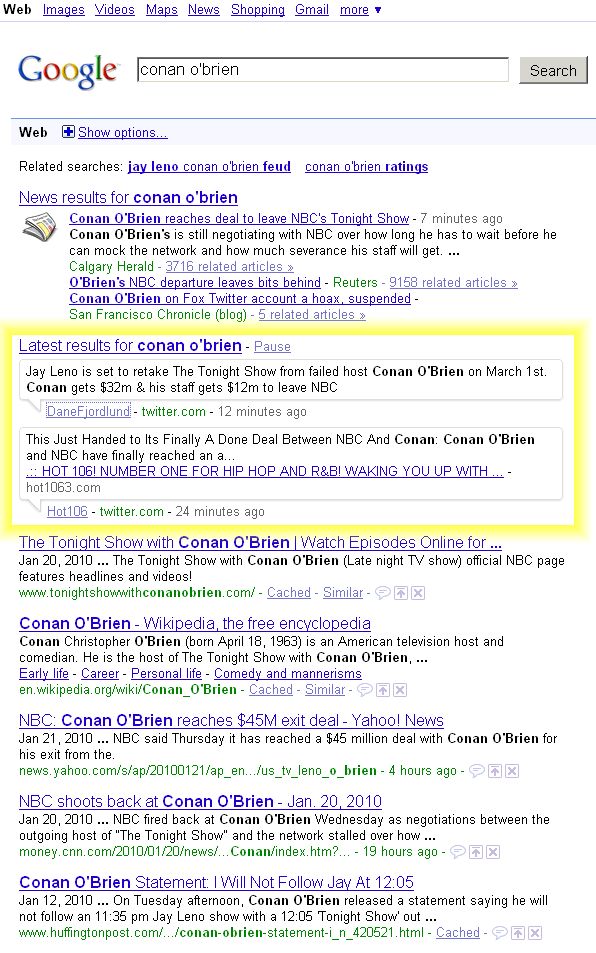
There I am doing an innocent Google search for the latest on the Conan/Jay debacle when I notice results ensconced in freakin’ talk-bubble-boxes (see yellow highlighting):

Not OK, Google. If I wanted to search Twitter I would have fucking searched fucking Twitter. As if I didn’t feel had enough by this Conan craziness, now you gotta go search-resulting me comic-book style? F you, dude. Like I’d want to get my TV entertainment news from some hip hop radio station. Or this guy.  Totally lame.

Bigger picture, this is an unnerving turn in the world of internet search. That may sound dramatic. But. It’s hard enough as it is to click a credible source online without the Twitter vomit of no-name bozos appearing directly below legitimate news results — which are of questionable reliability to begin with, and yet the best we’ve got to go on. Throw a rock in the air you’re bound to hit someone stupid. Throw a query in the Cloud you’re bound to hit his latest tweet. Blerg.

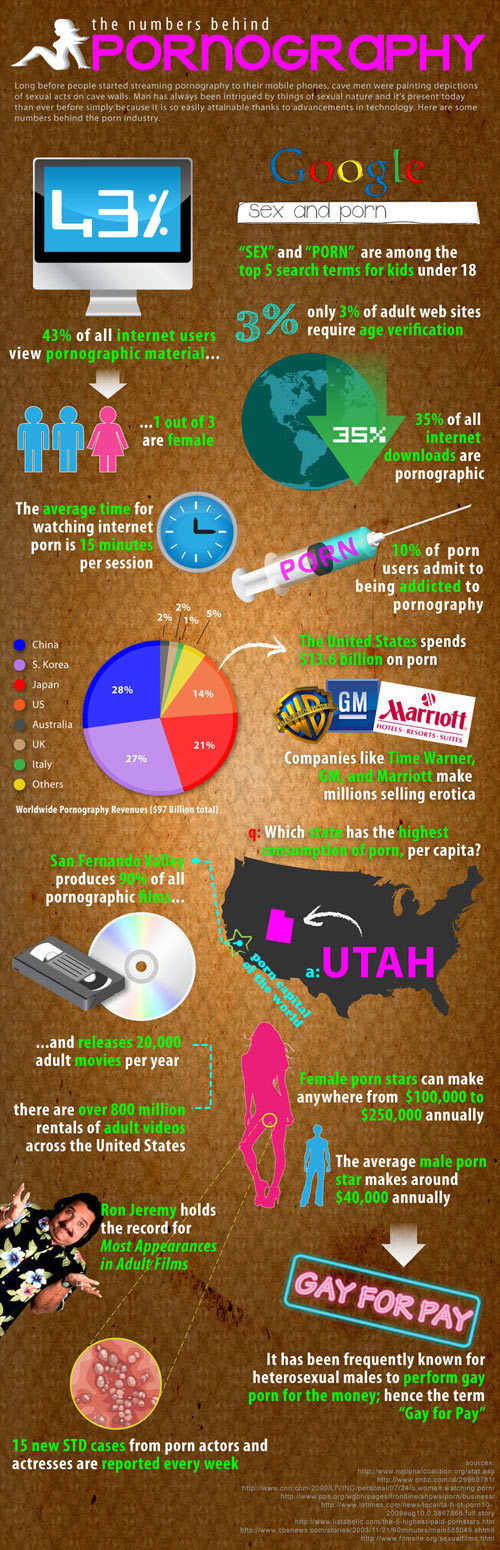
More groundbreaking news: People love porn

The real news here? Ladies, we’ve obliterated the latex ceiling.

But seriously, is that graphic blow up of a diseased snatch really necessary? And reported where, AVN? (Don’t open that at work. FYI: AVN Magazine is described by its publisher as the Bible of the adult industry.)

[via Gizmodo via 9Gag via TheNextWeb]

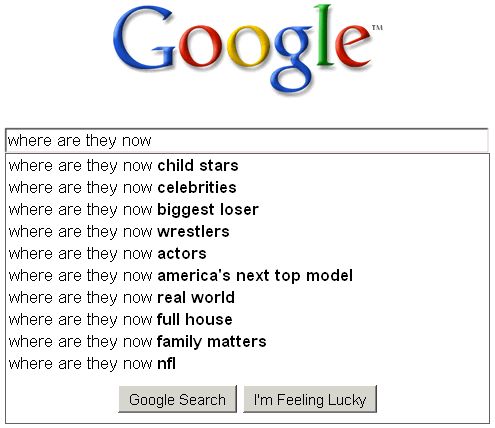
Google Game: Where are they now?

No surprise that reality TV stars and generic celebrity searches top the most popular Where Are They Now queries. But I get a little swelling of pride in my TGIF when I see that Full House and Family Matters are still on the minds of the people.

Have mercy.

One-Word Review of James Cameron’s Avatar in Digital 3D

Meh.