Take for the Weekend and the Back End

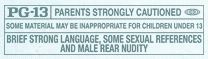
Weekend box office grosses put The Expendables on top with a $35 million take, with Eat Pray Love’s $23.7 million gross on its tail. Speaking of tail, be aware that if you go see this girly adaptation, you’re in for some “male rear nudity.” The MPAA’s warning:

Do we really need our movie ratings to be this specific? I’d like to see the label on a rerelease of Boogie Nights.

Stick it to the Media

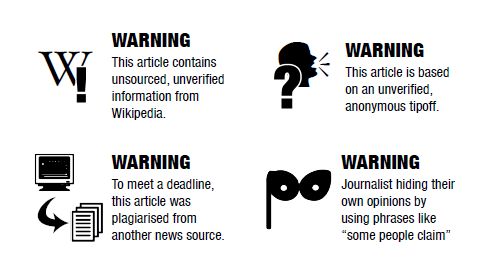
A man after my own heart. Self-described “geek comedian” Tom Scott has created a series of Journalism Warning Labels you can slap on your favorite — or least favorite — rag as a public service to other readers. Or as a stickily satisfying way to physically manifest your rage and disgust.

And how thoughtful, the kindly Brit included a link to a PDF of the labels that prints properly on standard American Avery sticker sheets.

Too bad we don’t have these for online publications. Of course if we did I wouldn’t be able to see my screen anymore. Too cluttered with labels like:

Warning: This post has been written by click whores riding the wave of this hour’s latest “news” story. There is nothing of value here.

Warning: Author has absolutely no credibility.

Warning: By clicking this link you are willfully contributing to the slow and inevitable degradation of human intelligence.

Warning: This video is not funny. The friend who sent it to you is wrong. I don’t care if he usually has the same keen sense of humor as you do. He’s wrong. It’s not funny. At all. Don’t waste your time.

[via Boing Boing]

Morning Mindfuck

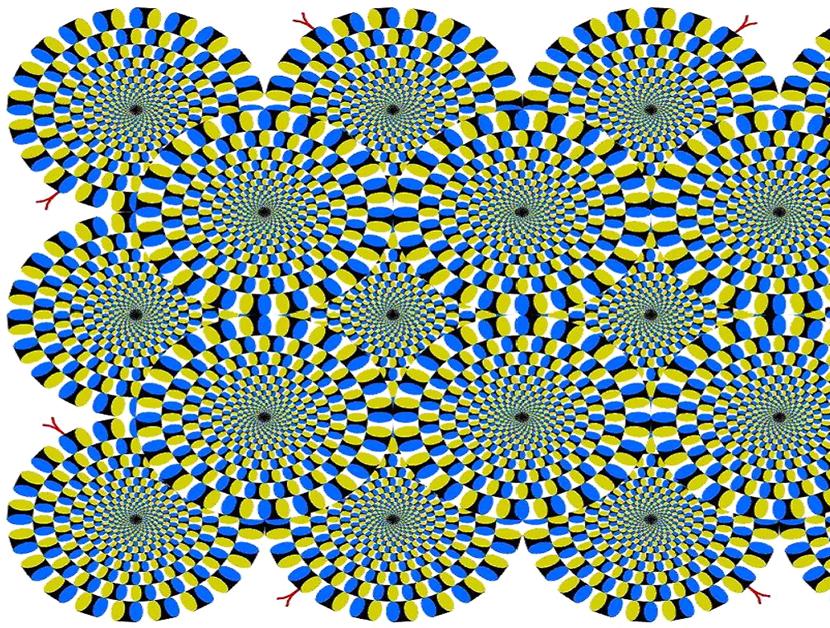
Good morning. Look at this shit. Think it’s moving? Well it’s not. I swear. Just a jpeg, kiddos. Focus even briefly on just one central dot and you’ll see it “stop.” Booya. Mindfucked.

Online, Hate, Love and Minimal Curiosity Are All Equal


I care not for you, yet still I click.

If we weren’t so bored, you wouldn’t be famous.

Once upon a time you got word of a good book and you had to read the thing to join the conversation. Then a couple hours in the cinema caught you up on the latest movie. Then half an hour in front of the tube. And so on. Now thirty seconds at the computer is enough to turn any no-name into a sensation.

Here’s the problem with the internet being free and accessible: it’s lowered the bar irremediably.

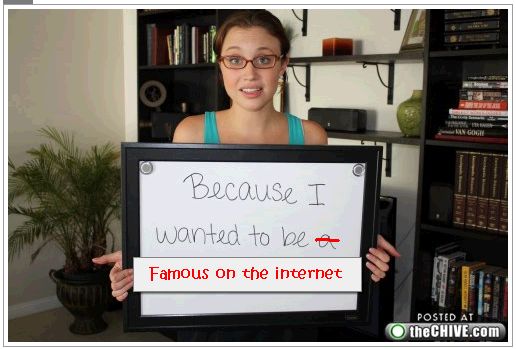
So not only can an idiotic hoax, like the Hot Jenny Quits via Whiteboard, jpeg put-on, reach near-immediate saturation, but there’s no way to differentiate between the clicks of the gullible and the clicks of the academically curious. A web-surfer forwarding on the series of 33 utterly uninspired photos of “Jenny” “quitting” her “job” with lame wannabe witticisms on a whiteboard has the same clickrate value as, say, a curmudgeonly blogger doing her minimal due diligence before ranting about how stupid the whole thing is. Moreover, it puts imaginationless attention whores on virtual par with true visionaries like Steven Slater, the Jet Blue flight attendant who put in his two-beers notice while riding the inflatable slide off a plane at JFK.

That's right, I said visionary.

We’re never going to win the war on bad taste. Reality TV has taught us that, if nothing else. And, sadly, there’s no way around the democratic equanimity of the web that makes every click matter. If there were an Internet Constitution I’d move that stupid people be given 3/5 of a click, but alas, it shan’t be so. In lieu of a “solution” I offer at least a way to balance the scales. For every one thing you read online that makes you feel dumber for having read it, click on one thing with the potential to edify or inspire. At the very least, maybe we can each emerge from a day at net zero (if not on the emergency raft). Call it the new net neutrality.

Google Game: Jesus of Bethlehem vs Justin of Bieber

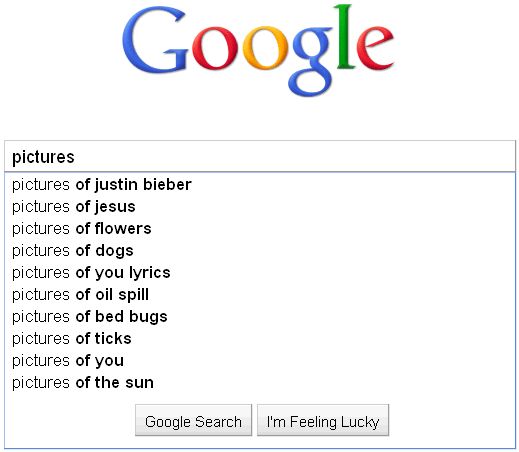
What can I say about a society in which there are more people online searching for pictures of Justin Bieber than for pictures of Jesus? Just this: Hail progress!

For two thousand years Jesus has ruled the Billboard Icon charts. And what has it gotten us? War, cultural upheaval, genocide, televangelism, Creed. Enough is enough. Let us declare his reign of terror over and install in his place a new boy-ruler. Who better than Justin Bieber? His coif, if not his conception, is immaculate. He fairly floats above the ground as he leads throngs of devoted followers.

And, in a one-up over the messiah, he’ll be out of style long before he hits his early thirties, allowing his disciples to transfer their feverish worship to another false idol before things get too serious.

We have the collective memory of a concussed goldfish and are as imprintable as a flock of retarded ducklings. We transfer our infatuations from celebrity to celebrity on a near-daily basis, yet we hang onto religious fanaticism with a kung-fu grip. It would be safer and easier for everyone if we just treated the Jesuses of the world a little more like the Justin Biebers. Fear not, there’s room for both in Heaven — and on VH1’s I Love the Zeros.

Voiding in the Void: Space Exploration and Fecal Decapitation

If you missed this Daily Show interview last Monday, watch now and let it brighten this one. Poop! In Space!

Vodpod videos no longer available.

Just a little weekday escapism, if you will. By the way, if you’re unfamiliar with Mary Roach, I highly suggest checking out her books, especially Stiff: The Curious Lives of Human Cadavers. She’s a brilliant reporter and a fantastic writer. I want to be her when I grow up.

Readability: More than Legibility

Read, here, a letter dated July 1957 from JD Salinger to the hopeful producer of a film version of The Catcher in the Rye. Salinger was known for his cantankerous resistance to over-commercialization of his art. Whether he’d burn all his unpublished works before he died was once a popular topic of cocktail party conversation amongst literati and wannabe-literati alike. (One night I was engaged in such a discussion while sitting in an empty bathtub on a sidewalk in Alphabet City. Doesn’t get much deeper/hipper than that.)

Take a minute with the letter, posted on LettersofNote.com. The tone is fantastic, an expert blend of fluency, insolence and humor. For all his pomp (fully merited) I think Salinger takes a remarkably analytical tack, neither overly-personal nor defensive. And he calls himself “super-biassed,” which is just gold in my opinion. My favorite part, however, comes at the very end:

Thank you, though, for your friendly and highly readable letter. My mail from producers has mostly been hell.

Highly readable letter! This shouldn’t be rare, but it is.

I really try with my letters (which, naturally, are almost entirely electronic). I use full sentences, proper punctuation, capital letters. I aim not to simply write emails, but to craft them. Do I shoot off quickie emails and text messages? Absolutely. But in professional communiques, and even to my closest friends, I typically attempt to express myself clearly and to convey my literal message along with a sense of emotional context, be that enthusiasm, outrage, humor, hopefulness, bleak resignation, what have you. What I write reflects me and whatever cause I’m representing.

Which is why it pains me to read emails that indicate an utter lack of care — or proofreading. It’s embarrassing for the author and disrespectful to me. We don’t have time in our busy days to pen a novella every time we need to write an email, but we can do one another the simple courtesies of carefulness and attention. Maybe from time to time we can pause before hitting Send and ask ourselves, what would JD say about this?

I encourage you to check out more letters on the site, like this vintage gem from the editors at Mad Magazine. Editors, if you’re reading this, I’d love to get a form letter like this instead of being routinely ignored. Just saying.

[Thanks, Cathleen.]

Dads Say the Darndest Things

This fall CBS will air a new show based on the popular Twitter feed Shit My Dad Says, or @shitmydadsays for those of you who are no longer comfortable with capitals and spaces. The sitcom stars William Shatner, who’s really running with this career renaissance thing, and would be the ideal vehicle for lines like…

“They’re offended? Fuck, shit, asshole, shitfuck; they’re just words…Fine. Shitfuck isn’t a word, but you get my point.”

…if only you could say things like that on CBS. To keep it family-friendly — and contrary to Shatner’s opinion — the show is called $#*! My Dad Says, where $#*! is pronounced “bleep.” (Related: Does anyone know how to say Dance Your A** Off? I’ve never had to, but what if I do?)

Unfortunately for fans of Shatner and fathers without filters, the show looks borderline atrocious. They should have gone with Tourette’s Guy.

Don’t talk shit about Total. And fuck salt.

Google Game: So much fun?

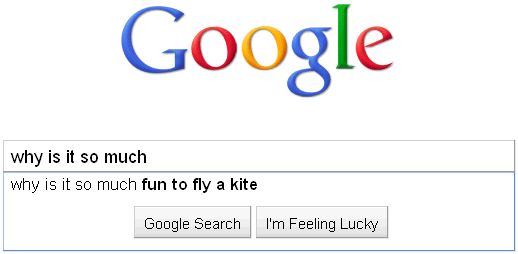
Summer is a time for lounging in thought. Temperate climes cultivate contemplation. Clear skies clear heads. Each year, lulled into musing moods by sunshine and slower paces, I find myself at the park or the beach, surrounded by short-pantsed and swim-suited revelers of summer’s simpler pleasures, looking up toward cotton clouds and thinking, What the fuck is so much fun about flying a kite?

Seriously. Why is that fun? Evidently I’m not the only one who doesn’t get it. And you know what? Google doesn’t even have an answer to it. You know why? Because kites are fucking stupid. Yeah, OK, if you’re, like, five, anything that’s sort of like flying is cool. But other than that, kites are dumb.

Oh, and fireworks? Fucking overrated. There, I said it.

It’s Not I, It’s Me

Hand I that book, won't you?

Nothing makes you sound stupider than trying too hard to sound smart. (OK, maybe not nothing, but allow me my indignation.) This is why it pains me every time I hear someone use “I” when he should say “me” and “whom” when it ought to be “who.” I can forgive innocent misuse in the kinds of complex grammatical scenarios that call for the I/me and who/m determinations. But there are too often instances when it’s clear the speaker is trying to prove intelligence by opting for the smarter-sounding choice, and  it veritably reeks of desperation.

You don’t want to be this person. And I don’t want you to be, either, which is why I’ve provided this handy guide for when to whom and whether to I.

The two pairs are fairly analogous, and their use can be guided by the same simple principle. You use “I” and “who” like he, she, they, we, and you use “me” and “whom” like him, her, them and us. The New York Times Manual of Style and Usage describes it rather succinctly:

Use who in the sense of he, she or they: Pat L. Milori, who was appointed to fill the vacancy, resigned. (He or she was appointed.) Use whom in the sense of him, her or them: Pat L. Milori, whom the board recommended, finally got the job. (The board recommended him or her.) The same test applies to whoever and whomever: Whoever wins will collect $64. (He or she wins.) Whomever you ask will provide directions. (You ask her or him.)

The idea, if you want to get into the whys, is that of subject versus object. In grammar a subject does things, an object has things done to it. Read on for a detailed explanation.

Continue reading