Sun’s Schwartz Tweets Larry Ellison the Finger in 5-7-5

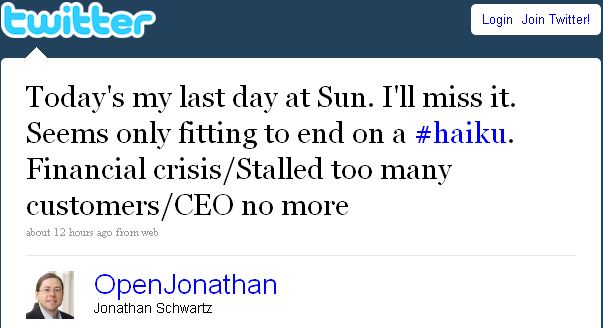
I guess it’s official: The Internet has killed formality. Today we add another awesome resignation to the annals of unprofessionalism, and watch executive dignity go the way of the Full Sentence. In the wake of an Oracle takeover, Sun Microsystems CEO Jonathan Schwartz tweeted his way out the front door:

Of course we all must know that this is not actually how he tendered his resignation, despite BoingBoing’s assertion of such. Though, it’d be a lot cooler if he did.

[via NYT via BoingBoing.]

More Fun with the iPad (abusing it, not using it)

The technopundits spent months (years) hot under the collar waiting for the dawn of the iPad. And now that it’s here it’s caused a dizzying deluge of excitement commingled with bewildered disappointment and acrid bemusement. I’m gonna go ahead and jump on that last one. Never been a big Kool Aid drinker.

So, here’s a phrase I never thought I’d say: Hitler was on the money. Behold.

Adolf makes a great point I forgot to bring up in my earlier post: No Flash support. No Flash support?! How’s ol’ Jobsie going to make an essentially dedicated web-surfing device that doesn’t support Flash? It’s baffling.

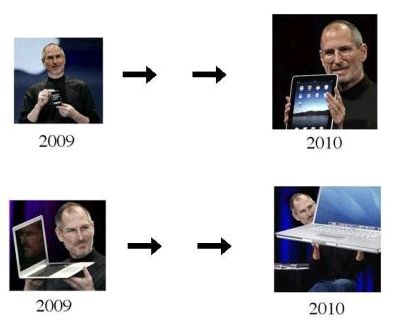
And on a related note, a pretty nice little graphic of Apple product evolution: (source unknown)

Don’t you love the way SJ’s peeking out from behind his soon-to-be-released iSorry?

[Thanks, Dror & Jeff]

Google Game: Why can’t I…?

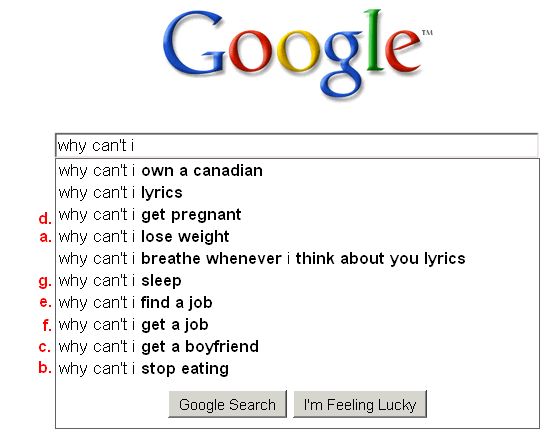
For this week’s game we’re going to take it down in two parts.  The top result doubtless has caught your attention by now, but we’ll return to that shortly. First, let’s tackle the seven items I’ve labeled a-through-g:

a. See (b.)

b. See (e.)

c. See (a.) & (b.)

d. See (c.)

e. See (f.)

f. Rewrite your resume, see (a.)

g. See (f.) & (c.) & (a.)

Now, click through for more on Canadians, and why you can’t have one.

Continue reading

Haitian Women Channel Aristophanes

CNN reports today that women in Haiti have barred men from food aide sites. Seems the not-so-gentle men were pushing and fighting and causing unruly scenes, and are no longer allowed to collect emergency relief rations.

Vodpod videos no longer available.

If you’ve studied the Classics, or are a freelance tech writer with too much time on your hands, perhaps you’re familiar with Lysistrata, by Greek dramatist Aristophanes. In the play, a bawdy, excessively double-entendre’d, proto-Benny Hill political comedy, women are fed up with their men’s propensity for war, which is tearing the country asunder. So, led by a loudmouth named Lysistrata, they take over the Acropolis and citadel and promise only to relinquish them once a peace accord is assured.

Lysistrata
…the women have taken the Acropolis. Athene’s Citadel is ours!…
Let’s hurry inside the Acropolis and help the others shoot the bolts.

Kleonike
Don’t you think the men will send reinforcements against us as soon as they can?

Lysistrata
So where’s the worry?
The men can’t burn their way in or frighten us out.
The gates are ours — they’re proof against fire and fear — and they open only on our conditions.

Kleonike
Yes! That’s the spirit — let’s deserve our reputations:
Up the sluts!
Way for the old impregnables!

In truth, their strategic position is not the real bargaining chip. The ladies achieve leverage through sex, and the withholding thereof until an agreement is reached. (To be sure, it’s not easy on them, either; Aristophanes’ women are as horny as they are Hellenic.)

Men in Haiti can certainly empathize to some extent with the leader of the men’s chorus in Aristophanes’ play:

I won’t be played to revise, re-do,
amend, extend, or bring to an end
my irreversible credo:
Misogyny Forever!
–The answer’s never.

[Above translation by William Arrowsmith and Douglass Parker. Sometimes the translation feels fatuously over-the-top. For a free download of the work by other translators (I assume) try Gutenberg, or EServer.]

iCave

OK, OK. I cave. I have to talk about the iPad. I get it. On my failure to address last week’s most impactful appearance of an important public figure, I’ve not much to say. iPad? My bad. And I reckon this will make me a heretic among my tech brethren (a heretech?), but I pretty much don’t give a hoot. In a word: yawn.

It’ll be interesting to see how the technology is adopted and its release marks a crucial starting point for a new wave of netbook-obliterating, better-than-e-reader devices, but I don’t see an iPhone-esque groundswell/sea change (choose your geometaphor) happening just yet. It’s way better for reading than a Kindle, they say (I haven’t had a hands on), but it’s not like we’re all toting those puppies around. Otherwise, it seems like an oversized iPhone. An oversized iPhone that doesn’t take pictures. Or, you know, make calls. Yet still has a pricey 3G plan with famously spotty service to go along with it.

And as for other sad similarities, how the hell did they let this thing out of the box without multitasking functionality? You know how you can’t play music with the Pandora app on your iPhone while look something up on Google? You won’t be able to do that on the iPad either. Truly idiotic. Hey, check out this cool little ‘puter — it does one thing at a time!

Surely we’ll be revisiting the long-heralded tablet, and in the meantime I’d be remiss if I didn’t jump on the wagon and bring you MadTV’s prescient iPod/iPad spoof circa 2006:

Reader Appreciation: Really, what are the odds?

Thanks to the reader who found the site by searching
mountain dew mead.”

See: Mead, M’Lady? Prithee, Mountain Dew

The Triumphant Rise of Urology, and Other Nerdtastic Trendlines

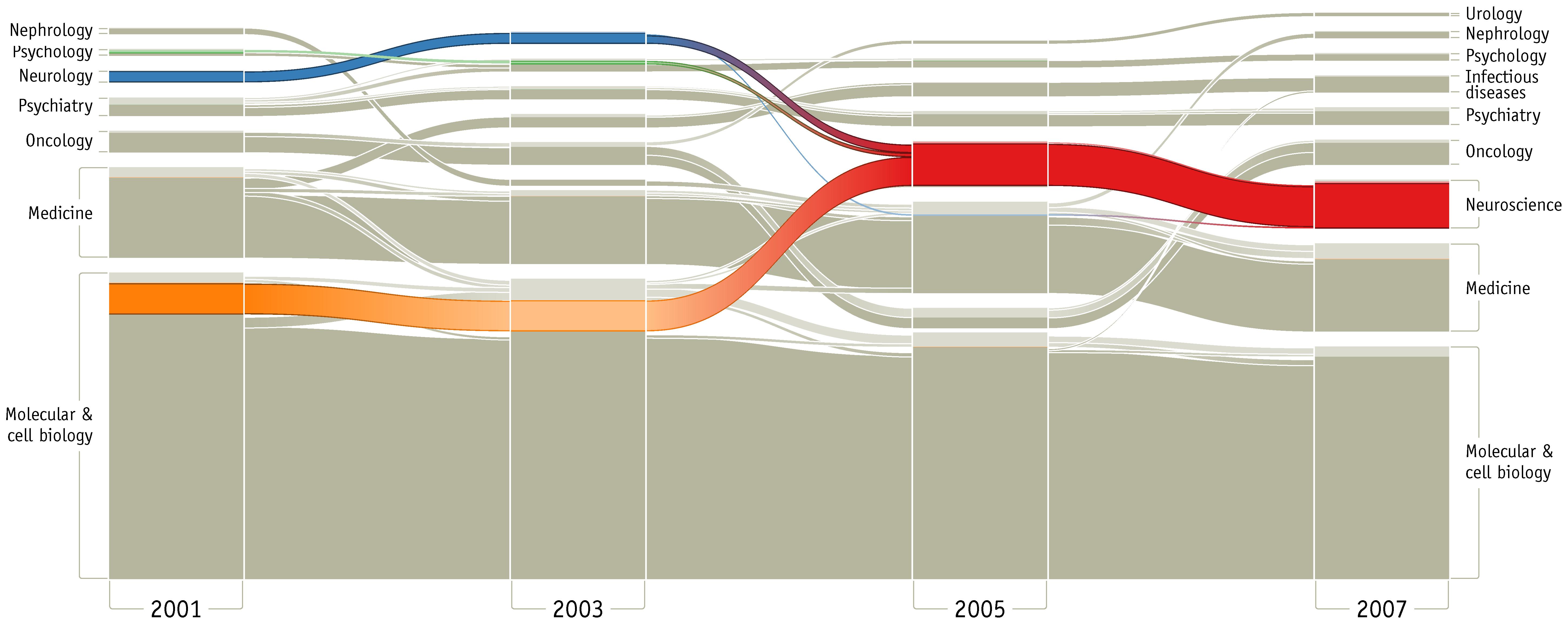
Analyzing 35 million citations from 7,000 journals, researchers at the University of Washington and the Santa Fe Institute have traced and plotted changes and fluctuations in the prevalence of various fields of scientific study over the past decade.

Among the most notable observations are the branching of broad study areas into more specialized, standalone disciplines, and the emergence of newly defined fields, such as neuroscience (which was, indeed, an interdisciplinary concentration when I majored in it — or something like it — as an undergraduate in the nascent millennium):

The alluvial diagram illustrates, for example, how over the years 2001–2005, urology gradually splits off from oncology and how the field of infectious diseases becomes a unique discipline, instead of a subset of medicine, in 2003. But these changes are just two of many over this period. In the same diagram, we also highlight the biggest structural change in scientific citation patterns over the past decade: the transformation of neuroscience from interdisciplinary specialty to a mature and stand-alone discipline, comparable to physics or chemistry, economics or law, molecular biology or medicine.

Also worth remarking: the conspicuous lack of progress in the field of making graphs that don’t give you a migraine.

(Published in PLoS ONE.)

Bulk Mail Bards

Not so long ago we looked at an awesome piece of spam mail that seemed acutely aimed at the Unhappy Mediator’s proclivity for the scientific. Well, yesterday I found myself once again immersed in my junk folder, and the language lover in me was struck by the inventive word choice and unusual rhythms of a handful of emails. They were downright… poetic. Indeed, the subject heads and first lines seemed to form perfect lyrical couplets. Below, a selection that would give even Chaucer a chubby. Shake William’s spear. Thaw Robert’s Frost. Make ee cummings. I’ll stop, I’ll stop.
Sad truth on your size
Potion for heroic banging

Avoid bed-loser’s fate
Love-skill increment

The night is a time to have fun in bed. Make this fun lasting!
Best girl-digging skills

Need your knob up?
Any girl will stay with you

I got a lot about you
In shape for making it?

Harder banging is real
Exploding ardor every night

Want to see her happy tears?
Don’t pay for delivery

High amour degree
Shoot your gin into her vagina

10 seconds and it’s up and firm
Confirm on receiving

Google Game: Quotes

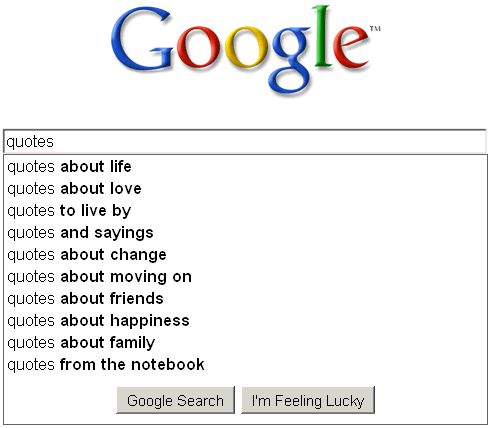
Nuptials. Breakups. Friendship. New baby, job, home, direction. When something profound happens we look for words worthy of the occasion. Then we realize that we have no idea what to say. But someone else must. Aha! Quote a famous person! Someone smart and eloquent and insightful and not you. To the internet!

Looks about right. Life, love, moving on, happiness… The Notebook? Geesh. When I found that I took a breather, then redid the same search and found a rather hilarious surprise substitution…

Continue reading

Ralph Waldo Emerson Would Probably Call You a Pussy

Logic leads to advancements, which in turn dictate logic. Why call someone when you can Facebook them? Why scan the street for an address when you can check the location on your iPhone? You could pick up a book on a subject of interest, but instead you’ll search for a few sufficient snippets online. Could you plan a trip without Orbitz or Kayak or Google Maps?

Ralph Waldo Emerson wrote “Self-Reliance” in 1841, praising the strength of the individual, the value of unadulterated opinion, and revealing the folly of blind following. In it Emerson provides a poignant vision of technology’s subtle and subversive shifting of priorities and perceptions. More than a century and a half later it is still a vital reminder that whatever our tools and acquired facilities, we must rely, ultimately, on ourselves.

This passage may as well have been written today, about the Internet and cell phones. The message hasn’t lost a bit of relevance — OK, maybe a bit; Kiwis are, today, largely clothed, I reckon:

Society never advances. It recedes as fast on one side as it gains on the other. It undergoes continual changes; it is barbarous, it is civilized, it is christianized, it is rich, it is scientific; but this change is not amelioration. For every thing that is given something is taken. Society acquires new arts and loses old instincts. What a contrast between the well-clad, reading, writing, thinking American, with a watch, a pencil and a bill of exchange in his pocket, and the naked New Zealander, whose property is a club, a spear, a mat and an undivided twentieth of a shed to sleep under! But compare the health of the two men and you shall see that the white man has lost his aboriginal strength. If the traveller tell us truly, strike the savage with a broad-axe and in a day or two the flesh shall unite and heal as if you struck the blow into soft pitch, and the same blow shall send the white to his grave.

The civilized man has built a coach, but has lost the use of his feet. He is supported on crutches, but lacks so much support of muscle. He has a fine Geneva watch, but he fails of the skill to tell the hour by the sun. A Greenwich nautical almanac he has, and so being sure of the information when he wants it, the man in the street does not know a star in the sky. The solstice he does not observe; the equinox he knows as little; and the whole bright calendar of the year is without a dial in his mind. His note-books impair his memory; his libraries overload his wit; the insurance-office increases the number of accidents; and it may be a question whether machinery does not encumber whether we have not lost by refinements some energy, by a Christianity, entrenched in establishments and forms, some vigor of wild virtue.

We kneel at the altar of information on atrophied legs. Occasionally it would behoove us to get up and walk around.